Brand Growth, Brand Marketing 27 July 2026
Is Your Brand Positioning Still Driving Growth?
Positioning should not be static; it should be a system for growth.
The challenge is preserving recognizability while expanding relevance.
Scalable relevance enables brands to grow by expanding where and why consumers choose them.
The strongest brands evolve their benefit ladder and not their brand essence.
Sevendots, Milan
9 minute read
The central role for brand positioning
In the CPG industry, brand positioning is often regarded as one of the most enduring elements of brand strategy. Yet its value does not lie in remaining unchanged, it lies in its ability to continue driving consumer choice over time.
In fragmented categories, consumers are exposed to more brands, more channels, more promotions, fragmented media exposure and more substitutes than ever before. As a result, brands must work harder to remain mentally available.
Research shows that 58% of global shoppers say they are buying more brands across more categories than ever before.
Hence this distinction matters because consumers rarely reassess brands from scratch. Choice is often influenced by a combination of:
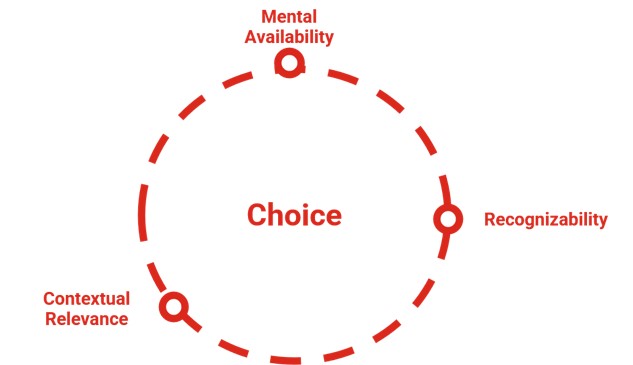
As a result, brands must work harder to remain mentally available and relevant when substitution becomes easier: distinctive brand assets help consumers notice and recognize brands, while positioning helps consumers understand why brands are relevant in different buying situations.
Positioning is one of the mechanisms through which brands sustain penetration growth. And penetration matters because brand growth is driven primarily by increasing penetration rather than significantly increasing loyalty among existing buyers.
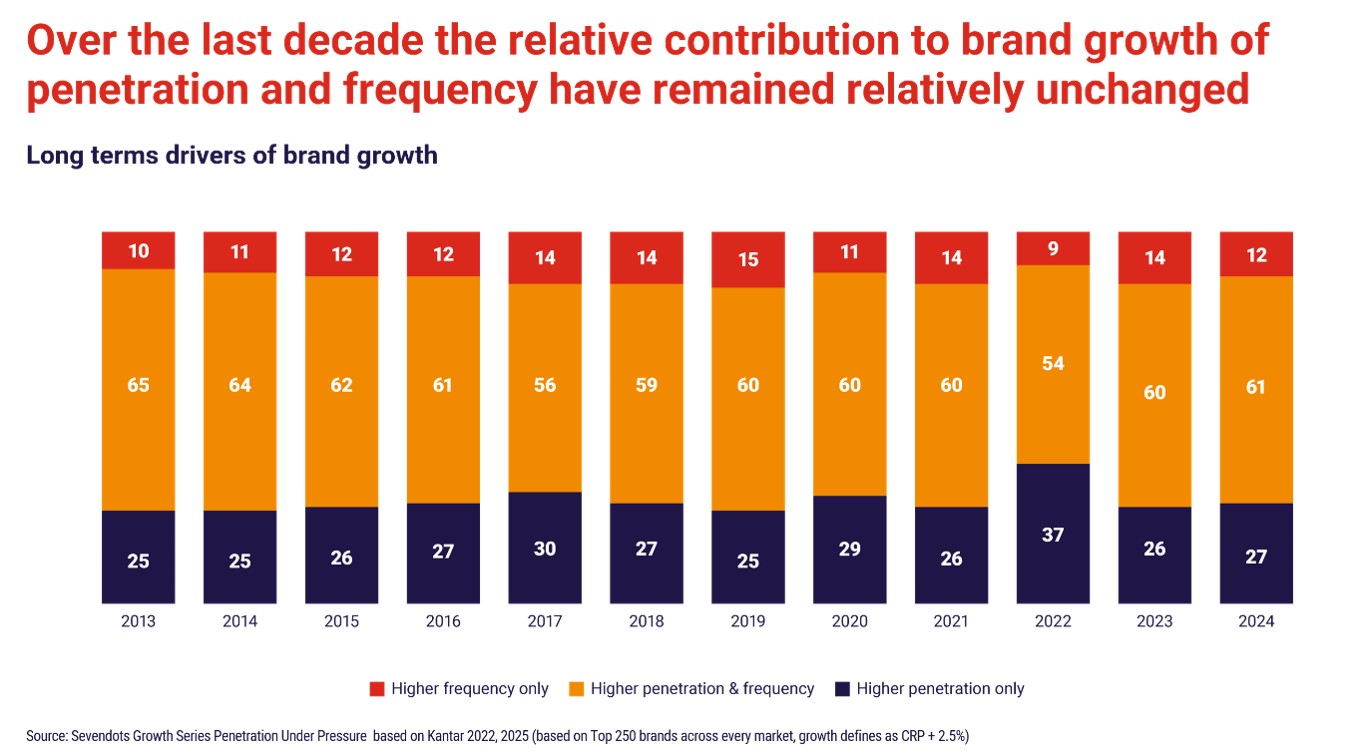
In other words, positioning is not only about consistency, but also about scalable relevance.
One of the most common misconceptions in branding is the idea that strong brands keep their positioning unchanged, but the reality is more nuanced.
The brands that continue to grow are rarely those that never change. They are the ones that understand which elements of their positioning should remain constant and which should evolve to stay relevant in new buying situations, occasions and cultural contexts.
This distinction becomes particularly important when brands attempt to:
- recruit new buyers
- enter adjacent categories
- premiumize
- scale internationally
- expand consumption occasions.
Because growth often requires the brand to become relevant in more contexts, of course without losing recognizability.
We refer to this capability as Scalable Relevance: a brand’s ability to preserve its core meaning while continuously expanding the number of contexts, occasions and category entry points in which consumers find it relevant.
The rest of this article explores why scalable relevance has become one of the most important capabilities for sustaining penetration growth.
The brand benefit ladder is not static
The way brands build relevance has evolved significantly over the past two decades.
Historically positioning systems in CPG sectors were often centered around functional superiority: better ingredients, better performance, better efficacy, better taste, better convenience.
However, market fragmentation, media saturation and the rise of digital ecosystems changed how brands create differentiation and mental availability.
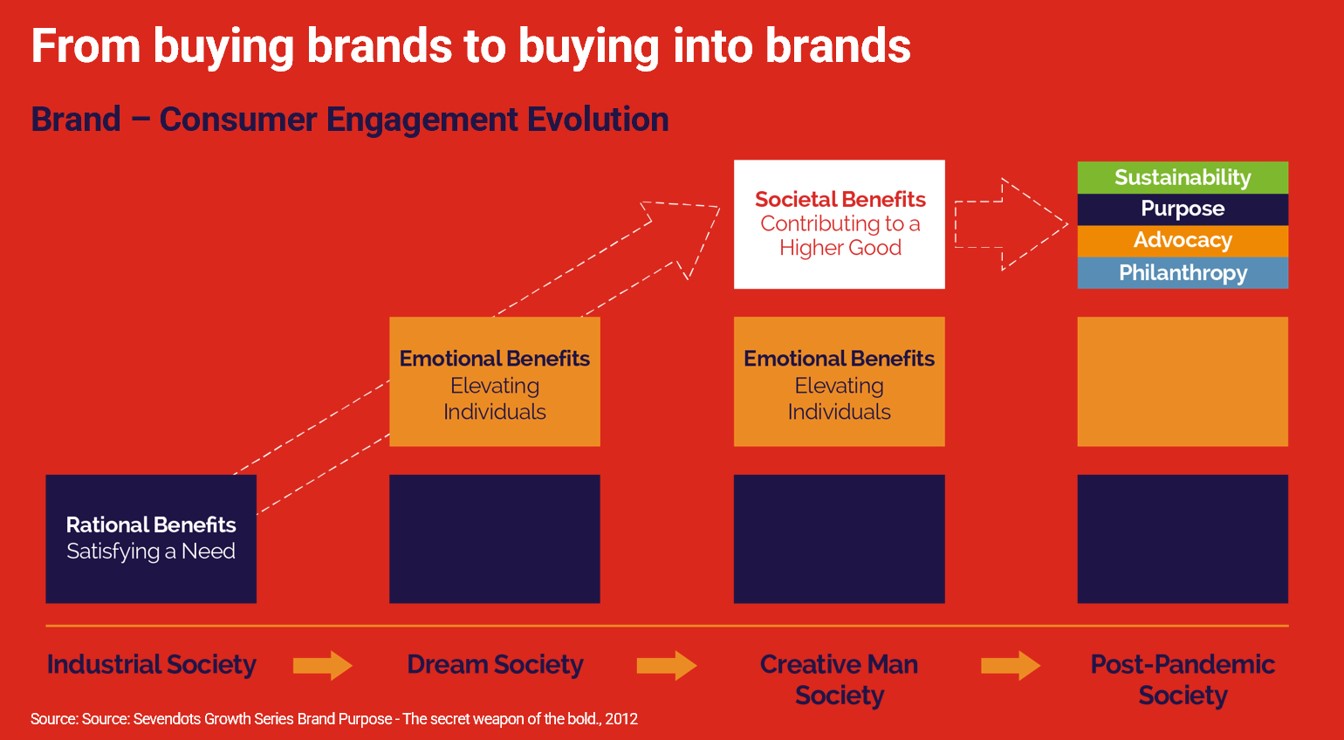
As communication became increasingly interactive and culturally driven, brands were expected not only to communicate product superiority, but also to participate more actively in consumers’ everyday conversations. This is one of the reasons why modern positioning systems evolved beyond purely functional benefits toward emotional and self-expressive or lastly purpose driven territories.
This does not mean functional positioning is irrelevant, but rather that benefit ladder has evolved and expanded.
As consumers become more attentive to topics such as health, wellbeing, sustainability, self -expression and social impact, many brands today expanded their positioning across multiple layers of relevance also considering these layers do not work independently.
The objective is not to necessarily to change what the brand stands for, but to make that meaning relevant in a broader set of consumption occasions, cultural contexts and buying situations.
In doing so is where many brands either unlock growth or dilute themselves.
As mentioned earlier, while distinctive brand assets reinforce mental availability and recognition across touch points, the evolution of the benefit ladder can be seen as a response to a broader growth challenge to continue expanding relevance and driving choice. Successful brands must have an optimal orchestration of the entire benefit ladder in terms of coherence and in terms of resource allocation, without losing recognizability.
We can identify 4 key layers of the benefit ladder:
- Foundational attributes
The distinctive concrete product or brand elements that makes the promise credible.
| Examples | |
|---|---|
 | Caffeine, taurine |
 | % of moisturizing cream |
- Functional benefits
What the product concretely delivers. Its functional superiority remains essential because it legitimizes the brand promise and supports credibility.
| Examples | |
|---|---|
| Energy boost |
| Softer skin, Gentle cleaning |
- Emotional benefits
How the brand makes consumers feel. This is where brands begin to expand relevance beyond pure product performance and create stronger emotional memory structures. Many mature CPG brands grow not by abandoning functionality, but “emotionalizing” it.
| Examples | |
|---|---|
| Feeling empowered |
| Self confidence |
- Self-expressive or societal benefits
What choosing the brand says about the consumer or the world around them. At this level the brand becomes not only a product choice, but also a symbolic or cultural signal. This is where purpose can play a role as a mechanism that inspires and reinforce coherence between the brand’s meaning, actions and societal relevance.
| Examples | |
|---|---|
| Extreme mindset |
| Real beauty, inclusive beauty standards |
The strongest brands tend to use purpose effectively when it amplifies an already credible positioning rather than replacing it.
Based on the layers of its benefit ladder, brand positioning evolution often does not require changing what the brand fundamentally means, but it requires to expanding the levels at which the brand creates relevance.
The strongest positioning systems are vertically coherent: each layer reinforces the credibility of the next ones.
As consumer expectations evolve – from health and wellness to sustainability and transparency – brands do not necessarily need to redefine their core meaning, however they need to selectively evolve the layers that make that meaning relevant and credible in contemporary contexts.
This allows them to:
- remain recognizable
- expand relevance
- increase mental availability
- enter more category entry points
- support penetration growth.
Strong positioning drives penetration
One of the most important implications, and maybe underestimated, role of positioning is its impact on penetration growth.
Growth comes when brands manage to preserve recognizability while becoming relevant in more buying situations at the same time:
- more buyers
- more occasions
- more contexts
- more consumption moments
This is where positioning becomes strategically critical and where we have to make sure it should not only answer the question:
“What does the brand stand for?”
but also:
“In how many relevant situations can consumers naturally think about this brand?”
This is where positioning becomes a growth system rather than a communication statement and this is where the evolution of the benefit ladder becomes important.
As consumers’ expectations evolve, brands need to selectively evolve:
- Benefits
- RTBs
- Emotional associations
- Cultural relevance cues
Without changing their core meaning, their brand essence. This does not mean reinventing the brand every year but increasing the number of situations in which the brand feels naturally relevant and easy to choose.
If we take again Dove as an example. It expanded from functional skincare superiority only toward confidence, self-esteem, and inclusive beauty. The results are well known:
- Broader cultural relevance
- Stronger emotional memory
- Expansion across categories and targets.
- Strengthened global penetration
However, in doing so Dove did not abandon its original positioning but expanded relevance across layers.
This is critical because penetration growth depends less on changing what the brand fundamentally means and more on increasing the number of contexts in which that meaning becomes relevant.
If you consider that Dove’s core brand essence has always been Care. What Dove did was not to change it but expanded across its ladder to:
- Care for your skin
- Care for yourself
- Care beyond beauty standards.
This is about scalable relevance.
A few cases around dynamic benefit ladder management
Dove — evolving the benefit ladder without losing the core
As demonstrating earlier, Dove is one of the clearest examples of this dynamic.
Originally, Dove’s positioning was rooted primarily in functional skincare superiority:
- moisturizing cream
- softer skin
- dermatological care


Over time, the brand progressively expanded its benefit ladder toward emotional and societal territories:
- confidence
- self-esteem
- “Real Beauty”
Importantly, Dove did not abandon its core meaning of care, but expanded the number of ways consumers could relate to that meaning.
The “Campaign for Real Beauty”, launched in 2004, is widely considered one of the most influential long-term brand platform evolutions in CPG to this day.
Coca-Cola — evolving execution while protecting memory structures
Coca-Cola offers another important lesson.
Over decades, the company has continuously evolved:
- campaigns
- visual systems
- digital experiences
- global activations
Yet the core territory remained remarkably stable:
- shared moments
- refreshment
- everyday pleasure
- positive social connection

When Coca-Cola launched its “One Brand” strategy and “Taste the Feeling” platform in 2016, the objective was not to reinvent the brand, but rather to unify and simplify execution globally while reinforcing emotional consumption occasions.
This illustrates a broader principle: strong brands often evolve expression aggressively while protecting the memory structures that drive recognition.
Oatly — expanding relevance through cultural positioning
A more recent example of benefit ladder expansion supporting penetration growth is Oatly.
The brand entered a highly functional category — milk alternatives — but expanded relevance through:
- sustainability narratives
- lifestyle positioning
- cultural distinctiveness
- provocative brand expression
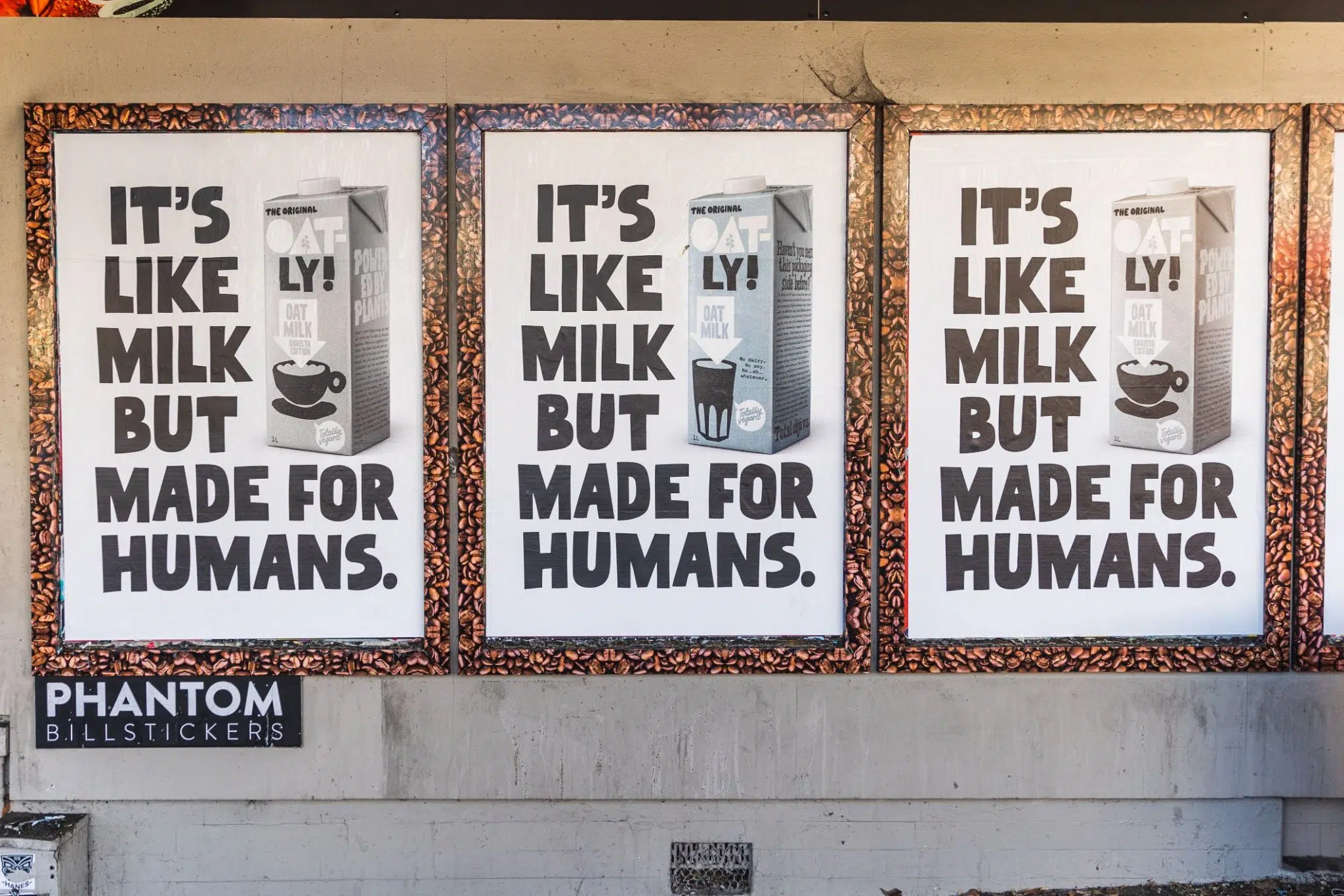
Its positioning evolved beyond “oat milk functionality” toward identity and worldview. This allowed Oatly to recruit consumers who were not only looking for a dairy substitute, but also for: lifestyle signals, environmental alignment, modern food culture participation.
CeraVe – expanding relevance by reinforcing credibility and expertise.
Unlike many beauty brands that built growth through aspirational imagery or emotional storytelling, like the case of Dove, CeraVe expansion was rooted in a highly credible functional positioning.
Its brand foundation remains remarkably consistent:
- ceramide
- dermatologist-developed formula
- skin barrier expertise
These attributes represent a strong Reasons to Believe of key functional benefits like hydration, skin repair. However, over time CeraVe expanded its relevance beyond functionality: through dermatologists, social media and skin care communities, the brand has been associated with:
- trust
- reassurance
- informed self-care

This is an example of growth comes not from dramatically changing positioning itself, but expanding the number of ways consumers can relate to it and reinforcing its RTB reinforcing expertise and credibility.
Final thought and conclusions
An effective brand positioning is not necessarily the one that remains unchanged forever nor is it the one that continuously reinvents itself.
The most successful brands tend to follow a more nuanced path: they preserve what makes them distinctive while selectively evolving what makes them relevant.
As the examples of Dove, Coca-Cola, Oatly and CeraVe demonstrate, there is no single formula for positioning evolution. Some brands expand through emotional and societal relevance, others strengthen credibility, expertise or cultural distinctiveness.
Some brands broaden their benefit ladder significantly, while others focus on reinforcing a limited number of associations more consistently.
What matters is not whether the positioning changes, but whether it continues to support growth by making the brand relevant in more buying situations, for more consumers and across more occasions.
For this reason, positioning should not be viewed as a static statement, but as a system that requires continuous evaluation.
A useful framework is to assess four interconnected dimensions:
1. Core Meaning
What the brand fundamentally represents in consumers’ minds.
This should generally remain stable and provide continuity over time.
2. Benefit Ladder
How the positioning is translated into a coherent system of consumer-relevant benefits.
From foundational attributes and functional benefits to emotional and self-expressive benefits: strong brands rarely rely on a single layer of relevance but they actively manage the entire benefit ladder, ensuring that each level reinforces the others and contributes to a coherent brand meaning.
3. Brand Expression
How the positioning is communicated through visual identity, storytelling, content and communication systems.
Execution often needs to evolve faster than meaning.
4. Activation & Category Entry Points
Where, when consumers encounter the brand: growth frequently comes from expanding the number of relevant occasions, contexts and consumption moments linked to the brand.
In conclusion, the objective is not consistency for its own sake nor is it changing for the sake of modernity.
The objective is to preserve recognizability while continuously expanding relevance because positioning creates growth not when consumers simply remember what a brand stands for, but when that meaning remains relevant enough to influence their choice over time. The objective is scalable relevance.
How Sevendots can support
At Sevendots we work with brand teams to transform positioning from a static statement into a practical growth system.
Our approach combines consumer insight, behavioral science and category analysis to help brands:
- assess the strength of their current positioning
- identify opportunities to expand relevance across new occasions, segments and channels
- strengthen the coherence of their benefit ladder
- reinforce mental availability and distinctive brand assets
- unlock penetration growth while preserving brand recognizability
Whether launching a new brand, revitalizing an established portfolio or entering new markets, we help organizations evolve positioning with confidence and with evidence.