Brand Growth, Business Strategy 20 April 2026
The Next Penetration Frontier: Rethinking Geographic Expansion for CPG Volume Growth
The traditional geographic expansion model is delivering declining returns.
The real opportunity is not where the category is big but where it is small.
Penetration growth will come mainly from creating new buyers, not fighting for the existing ones.
Sevendots, Milan
8 minute read
Slowing volume growth, untapped penetration opportunities
Large multinational CPG companies are facing a structural challenge: volume growth is slowing, a pattern observed in our ongoing analysis of the top global industry players.
In many cases, the issue is not brand strength. Nor is it portfolio breadth. The real constraint is penetration.
Across markets, most global brands still reach only a fraction of potential buyers. If volume equals penetration × frequency, and frequency growth is structurally limited, then penetration remains the most powerful lever for sustainable expansion as confirmed also in our recent study on the topic. In today’s environment, growth is no longer primarily about winning share — it is about expanding the pool of buyers.
Traditionally, companies have relied on three pillars to grow penetration:
- Portfolio strategy
- Channel development
- Geographic expansion
It is the third pillar, geographic expansion, that now deserves a fundamental rethink.
The traditional model: enter where the category is already sizeable
For decades, geographic expansion followed a relatively straightforward logic:
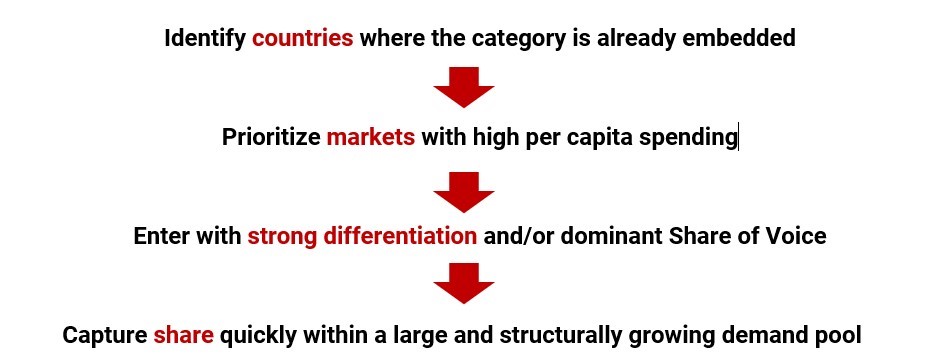
The bet was simple:
Large market + strong brand + heavy SOV = assured share gains.
This model worked. Many global icons scaled precisely this way. A brand like Oreo expanded lobally through a highly standardized model, often achieving modest share in each geography, but creating massive scale through breadth of presence.

Oreo benefits from the consolidation of moderate market share across 200 countries
Besides US and China, Oreo generally has a single digit market share in the cookie category across a very high number of geographies.
The underlying assumption was that market maturity reduced risk. If the category is big, consumers already understand it. You just need to win them over.
But that equation is becoming less reliable.
Why the ROI of the traditional model is declining
Two structural shifts are changing the economics of expansion:
- Media fragmentation makes effective SOV more complex and/or expensive.
Reaching dominance is harder when attention is scattered across platforms and formats.
- Meaningful differentiation is increasingly difficult to sustain.
Insurgent brands and growing private labels fragment the offer. Innovation cycles are faster. Competitive imitation is quicker. Distinctiveness decays more rapidly.
As a result, the classic formula, enter big markets, outspend, out-differentiate, is delivering lower ROI than it did 10 or 20 years ago. Growth is increasingly competed for, rather than created.
This doesn’t mean the model is obsolete, but it does mean it is no longer sufficient.
The alternative: expand where the category is still underdeveloped
There is an alternative path, one less explored by large multinationals, that shifts the game from competing for existing demand to actively creating new demand.
Instead of entering where the category is already strong, companies can target geographies where the category is still underdeveloped.
In this model, the objective shifts:
From stealing share – To building the category
The strategic focus changes accordingly. Rather than investing primarily in brand differentiation, the emphasis moves to:
- Category education
- Usage expansion
- Cultural embedding of the need state
- Prioritizing lower cost targeted engagement channels, including influencers
- Removing barriers to entry
In short: grow penetration by growing the market itself. This approach is based on a simple premise: those who build the category are best positioned to capture its growth.
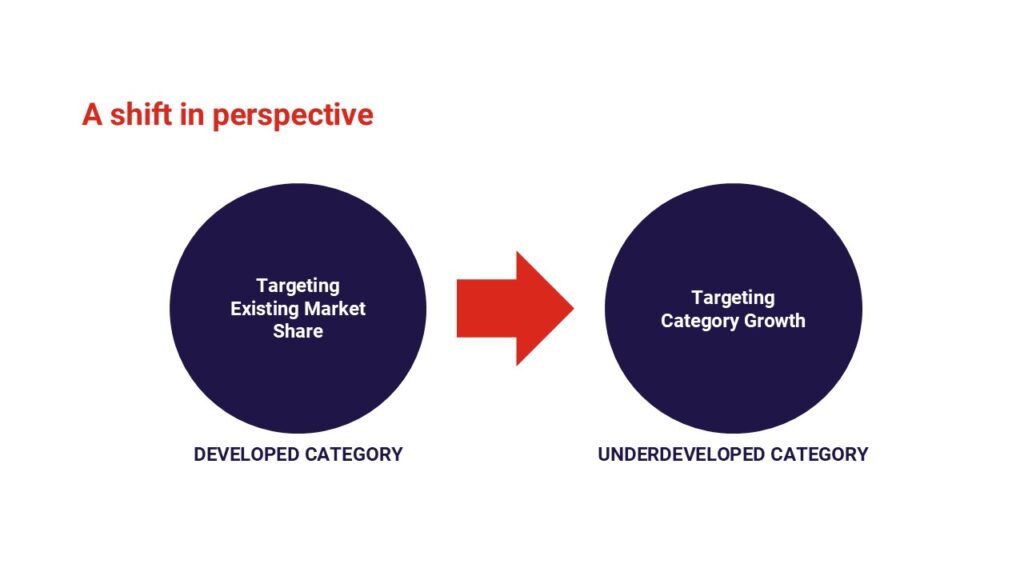
Higher risk but potentially higher return
This alternative model carries higher initial risk as category demand is uncertain and must be developed. Infrastructure may be weaker, requiring additional investment to enable category development. Overall, the short-term ROI is lower, and the payback periods are longer.
However, the upside can be structurally stronger. When a company helps build the category the competitive intensity is initially lower and private label pressure is limited. At the same time brand leadership can become structurally embedded as loyalty and mental availability can be established earlier.
While the traditional approach may still generate more attractive short-term returns, its efficiency is declining.
The “category building” approach, though slower, can generate disproportionate long-term value, especially for companies able to deploy scale, patience, and system-level capabilities.
In other words, the model trades short-term certainty for long-term structural advantage.
Penetration is the strategy — Geography is the lever
From a penetration perspective, the question becomes:
- Are you competing for buyers in mature demand pools?
- Or are you creating pools of new buyers altogether?
Geographic expansion is no longer just a market selection exercise. It is a strategic choice between:
- Share competition in developed categories – which is getting close to being a costly zero sum game
- Addressing new demands in underdeveloped ones – driven by sociodemographic development or by establishing new occasions and behaviors.
For CPG companies seeking sustainable volume growth, the second path may increasingly represent the next true penetration frontier.
From strategy to execution: how to identify where to play
Translating this into action requires a different way of assessing geographic potential.
The traditional mechanisms remain in place and don’t go away: identifying and then moving into geographies where penetration levels, and resulting market size and trends, are already attractive, checking the commercial conditions for doing business and assessing the retail and media landscape to successfully break in.
However, an additional and increasingly valuable lens takes into consideration category expansion potential and associated levers where current penetration levels are relatively low.
For example, consider the following:
In East Asia, roughly 90% of people do not use deodorants. This is partly due to genetic factors that reduce body odor. However, consumption is not purely functional, it is also cultural. As norms evolve, new usage behaviors could emerge. Companies that proactively shape these behaviors may unlock significant long-term penetration growth.


In Brazil 23% of individuals are heavy snackers (eating three or more snacks daily) while 51% are light users and about one quarter of the population does not engage in regular snacking at all. With the right offer, occasional/light buyers could represent a significant growth opportunity, given the lower barriers to consumption. This represents both a frequency opportunity and a penetration play across new consumption occasions.
Essentially, the model to assess penetration and volume growth potential becomes:
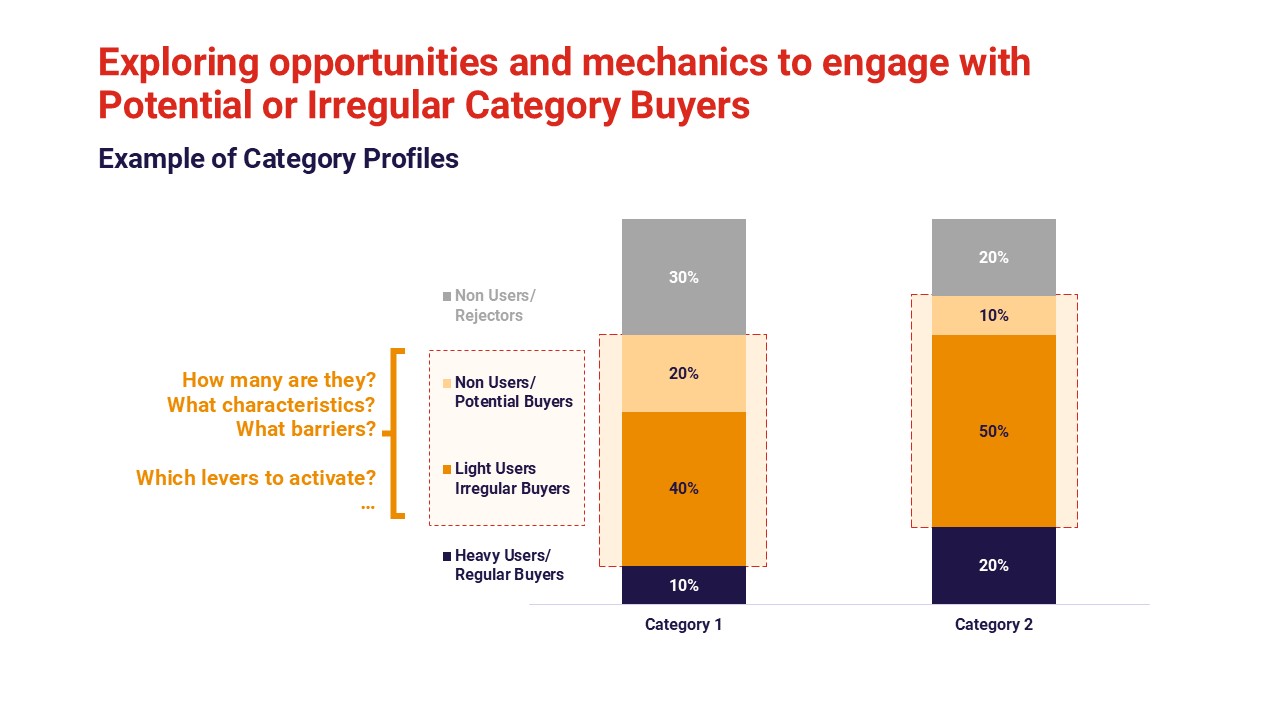
Categories are structurally composed of three groups: regular buyers, occasional buyers, and potential buyers among non-users. The job to be done for each group is different:
- Regular buyers – attract them through meaningful differentiation, mental and physical availability
- Irregular buyers – raise frequency unlocking new motivations and occasions
- Potential buyers – enter their consideration set by tapping into unmet needs or redefining the category equity.
The size of each group varies significantly by category and geography and defines the true growth opportunity.
This perspective is increasingly shared by leading industry players. A recent statement by Ramon Laguarta, CEO of PepsiCo, speaking during the Q4 2025 earnings call further supports the idea of looking beyond current category buyers:
“We’re thinking about growth in two main dimensions. One is making sure that our core brands continue to grow. Then we’re innovating in the periphery of the category where we’re seeing growth: there are consumers out there that are looking for us to give them excuses to come into the category.
These are mainly younger households. We’re thinking about innovation from a category-building point of view, bringing more consumers into the category, and obviously, driving frequency of the category.”
To tap into the two potential pools:
- Digital media and marketing innovation is much less risky, faster, and less expensive than new product development
- New product development is more likely to disrupt and bring new users into the category but high risk, high investment, and takes 24-36 months.
A resulting growth program should consider two dimensions:
- Short-term ROI/Growth – Optimize/innovate creative, content, and messaging to drive increased usage with lighter users
- Long-term ROI/Growth – Identify and build ideas for disruptive innovation that will bring in new users.
How to get started on this new path
Sevendots has developed an original approach with AI-powered Penetration Accelerator™ to profile and tap into both category light users/irregular buyers and category non-users/non-rejectors,
- Qualifying the different segments
- Identifying ways of engaging them
- Quantifying the incremental volumes at play.
Below there is a classic example of high penetration but structurally constrained volume.
Example – Potential to expand the candy market in Italy
(leveraging a replicable cost-effective modular market and consumer scan approach)
91% of Italians consume candies, and 57% do so at least 1–2x/week. But European industry data shows Italy as one of the lowest per capita consumers of sugar confectionery in Europe (roughly ~2 kg per person). So, while the majority of people buy and consume, usage is functional and situational, with limited occasions, smaller quantities, and self‑restriction.

Traditional expansion approaches would likely consider this market as mature with limited growth potential, but a closer look reveals the following insights:

A majority preference for sugar‑free (56%) strongly signals that “health permission” is shaping consumption.
And consumer sentiment echoes hidden barriers to more frequent usage “I like it, but I limit it” (guilt, dieting cycles, dental concerns); “I’ll only do sugar-free / functional” (mints/lozenges); “I avoid ultra processed / artificial” (ingredient skepticism can block both sugar and sugar-free, depending on sweeteners.
This sounds daunting, but what if a Brand could efficiently segment the market and target those light or non-buyers most open to incremental usage or trial if they could overcome these societal and health barriers?
Our recommendation was that a successful messaging and innovation strategy for overcoming health & permissibility barriers might include the following:
Message territories
- “Sugar‑free without compromise” (taste first, then permission)
- “Small, controlled moment” (portion + ritual)
- “Dental-friendly / breath confidence” (if scientifically supportable; be careful with claims)
Innovation bets
- Strong sugar‑free line with cleaner ingredient story (because some health managers distrust both sugar and sweeteners)
- Portion-controlled micro-packs; individually wrapped cues (self-control without abstinence)
- “Dual benefit” functional candy (breath + herbal, throat + soothing) with compliant claims
Would one more occasion a week from 57% of the population be worth the risk of trying a new expansion strategy? We think so, and advancements in Human + AI marketing and media platforms have made this type of targeted innovation much more efficient than ever before
Unlocking your next penetration frontier
In closing, if your brand or portfolio growth has slowed and global penetration has flat-lined or even declined recently, our team at Sevendots can help you think through a new growth strategy unlocking new sources of penetration by uncovering and prioritizing innovative geographic expansion opportunities for the next decade and beyond.
We help you driving penetration by identifying where to compete, where to create demand, and how to do it.
Our senior multidisciplinary team combines strategic rigor with hands-on execution to identify and activate high-potential geographic expansion opportunities based on optimized penetration.