Brand Marketing, Consumer Trends 30 September 2026
It’s All Gone Blurred: The New Reality of CPG Growth
The boundaries that once defined CPG are disappearing.
Consumers moved beyond the boxes companies still use to organize themselves.
Winning in a blurred world requires a new lens on growth.
Sevendots, Milan
4 minute read
Introduction
For decades, CPG companies built their strategies around relatively clear boundaries. Media created awareness while retail converted demand. Consumers shopped within identifiable channels. Generations displayed relatively predictable behaviours. And companies competed within well-defined product categories.
Those boundaries have been progressively disappearing.
What began with the fragmentation of media has spread to channels, generations and, increasingly, categories. The result is not simply four separate changes. Together, they are reshaping how consumers discover, choose, buy and use products and challenging some of the fundamental organizing principles of CPG companies.
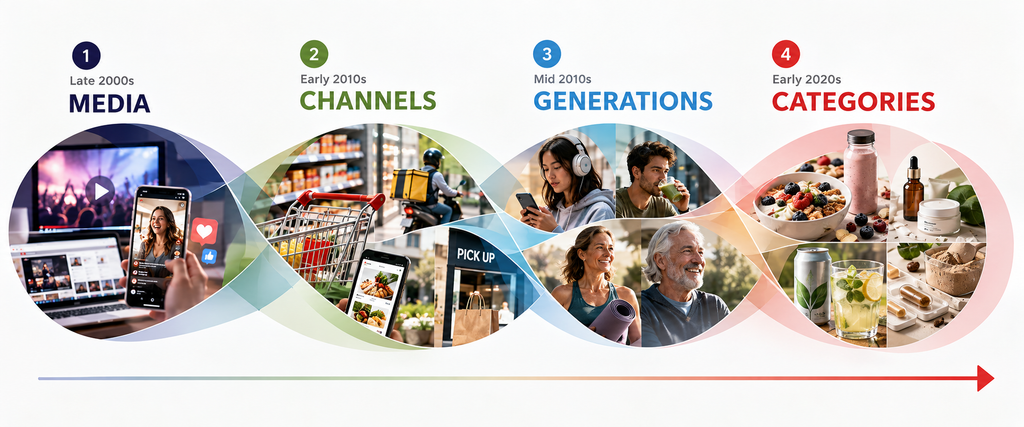
From media channels to consumer attention
The distinction between media and commerce is becoming increasingly difficult to make. Retailers have become media owners, while social and content platforms increasingly enable discovery, recommendation and purchase. AI is pushing this convergence further, potentially bringing discovery, evaluation and transaction into a single interface.
For consumers, this feels natural: one connected journey. For companies organized around separate brand, shopper, e-commerce, sales and media budgets, it is much more complicated.
The question therefore becomes less “Which media channel should we invest in?” and more “Where and how can we influence consumer attention and behaviour?”
From retail channels to shopping missions
A similar shift is happening in retail. Consumers increasingly choose how to shop according to their immediate need — convenience, price, speed, availability or occasion — rather than remaining within a single channel. The same shopping mission can move between supermarket, marketplace, convenience, delivery, social commerce and foodservice.
That changes the competitive frame. A lunch solution, for example, may no longer compete only with products sitting alongside it on a supermarket shelf, but with food-to-go, cafés, QSR, delivery and ready meals.
Winning therefore increasingly means understanding the shopping mission, and being available wherever and however consumers decide to fulfil it.

From generations to needs and life stages
Demographic segmentation is blurring too. Generations have not become identical, but age is becoming a less reliable shortcut for predicting behaviour.
Needs such as healthy aging, protein, sleep, cognition, gut health and preventive skincare increasingly span age groups. At the same time, behaviors once associated with younger consumers — digital shopping, social discovery or experimentation — extend much further across generations.
This suggests moving beyond asking “How do we target Gen Z, Millennials or Boomers?” toward understanding what is happening in people’s lives, what they need and what job they are trying to accomplish.


And ultimately, from categories to demand spaces
Perhaps the most profound blurring is now occurring between categories themselves.
Consumers increasingly search for solutions to needs and occasions rather than starting with the categories manufacturers use to organize their businesses. Snacks become meals. Foods deliver benefits traditionally associated with supplements. Beverages provide nutrition and wellness. Beauty extends into ingestible wellness.
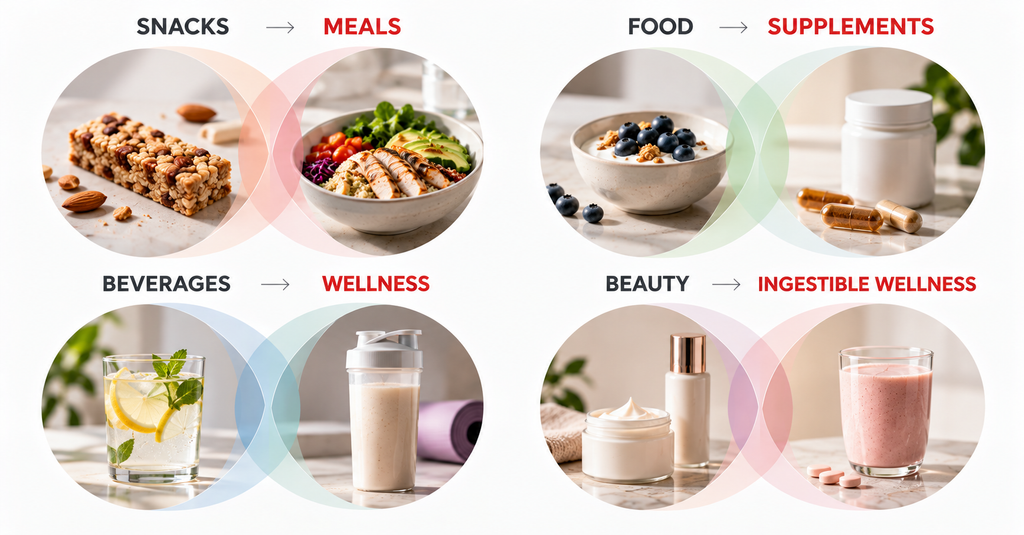
This dramatically expands both the competitive set and the potential growth space.
A company that thinks of itself only through the category it currently sells may overlook competitors coming from somewhere entirely different, but it may also underestimate how far its brands and capabilities could credibly stretch.
The strategic question shifts from “How do we grow our share of this category?” to “Which consumer needs and occasions do we have permission to serve?”
The bigger implication: reorganizing around the consumer
Taken together, these four waves point in the same direction.
Media channel → Consumer attention
Retail channel → Shopping mission
Age/cohort → Life stage and need state
Product category → Consumer need and occasion
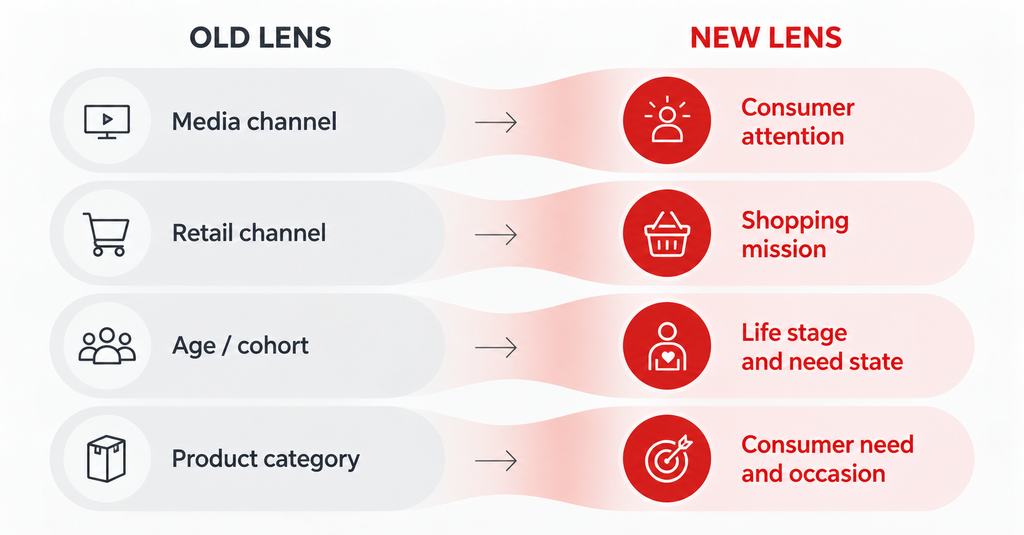
This is the central challenge of blurring: consumers are increasingly moving across the boundaries that companies still use to organize themselves.
The answer is not necessarily to dismantle those structures. Categories, channels and functions remain essential for execution. But CPG companies increasingly need a second lens that cuts across them organizing growth around consumers, needs, occasions and demand spaces.
That has implications well beyond marketing. It affects where companies search for growth, how they define competitors, how they build portfolios, how they innovate, where they allocate investment and even which KPIs they use to measure success.
In a blurred world, the companies that see beyond their traditional boundaries may find a much larger growth space on the other side.
Want to go deeper?
This article only scratches the surface of how blurring is reshaping the CPG landscape. In our full deep dive on Substack, we explore each of the four dimensions — media, channels, generations and categories — in greater detail, including what is driving the change, the challenges it creates and how CPG companies can respond.
Read the full article on our Substack.
At Sevendots, we help CPG companies identify and implement new growth opportunities by looking beyond traditional category, channel and consumer boundaries. From identifying emerging demand spaces to translating them into portfolio, innovation and go-to-market strategies, we help organizations turn a more complex and blurred marketplace into actionable choices. Our team brings extensive senior strategy, marketing and commercial experience from many of the world’s leading CPG companies. Reach out to us to explore where your next growth opportunities may lie.