Business Strategy, Category Growth 30 October 2026
Beyond the Usual Suspects: Why West Africa Deserves a Place on the CPG Growth Agenda
West Africa is moving from demographic promise to measurable CPG growth.
Winning requires a different growth playbook: affordability, availability and local relevance.
Better market visibility is changing the investment equation.
Capturing growth does not necessariliy mean owning the entire value chain.
Sevendots, Singapore
10 minute read
Introduction
For global CPG companies searching for their next source of growth, the list of priority markets has become remarkably familiar.
India. China. Indonesia. Vietnam. Perhaps the Philippines.
And with good reason. These are large consumer markets with attractive demographics and, in many cases, significant headroom for category development.
But what if the global CPG industry is looking at too narrow a map?
At a time when volume growth is proving difficult across many developed markets, and China has become a more complex growth equation for many multinationals, there is a strong case for taking another look at a region that receives considerably less attention in global boardrooms: West Africa.
This is not an argument for replacing Asia on the growth agenda. It is an argument for widening that agenda.
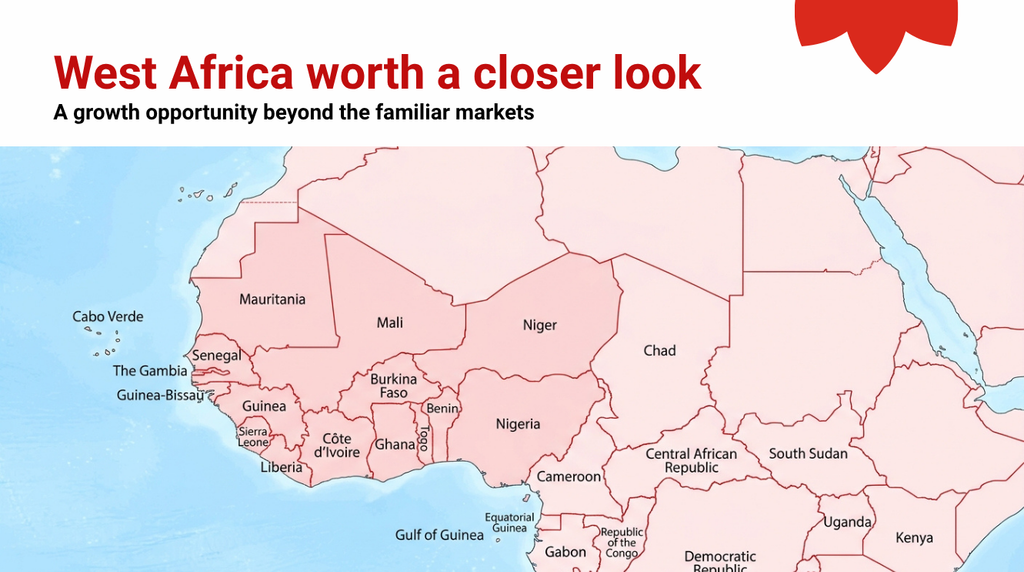
And there are increasing signs that the opportunity is moving beyond demographic potential to real consumer growth.
West Africa’s emerging CPG growth opportunity
Consider one of the world’s largest consumer goods companies.
In its 2025 results, Nestlé reported that organic growth across Asia, Oceania and Africa was 3.2%. But the geographic detail is revealing: Central & West Africa was among the strongest contributors to growth in the entire zone, alongside South Asia and the Philippines. Greater China declined.
That momentum continued into 2026, with Nestlé reporting real internal growth-led performance in Central & West Africa during the first quarter.
For global CPG executives accustomed to thinking of China and Asia as the natural homes of emerging-market growth, that comparison should at least provoke a question:
Are our investment priorities keeping pace with where consumer growth is actually emerging?
The long-term case for West Africa is familiar but nevertheless compelling. The region combines a young and growing population with rapid urbanisation, rising digital connectivity and significant headroom for the development of many CPG categories.
But demographic potential alone is not enough. CPG history is littered with markets that looked attractive in a demographic model but proved much harder to monetise.
What makes West Africa particularly interesting today is that we are beginning to see evidence of consumer demand translating into measurable CPG growth.
Ghana provides an interesting window into what is changing
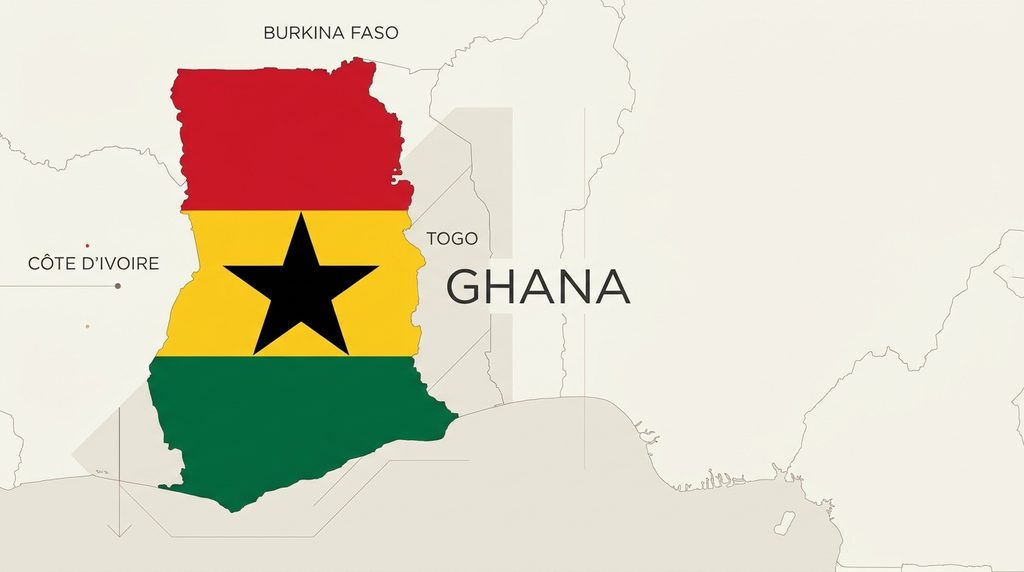
Recent data from Maverick Research, which measures CPG performance across West African markets, provide an unusually granular picture.
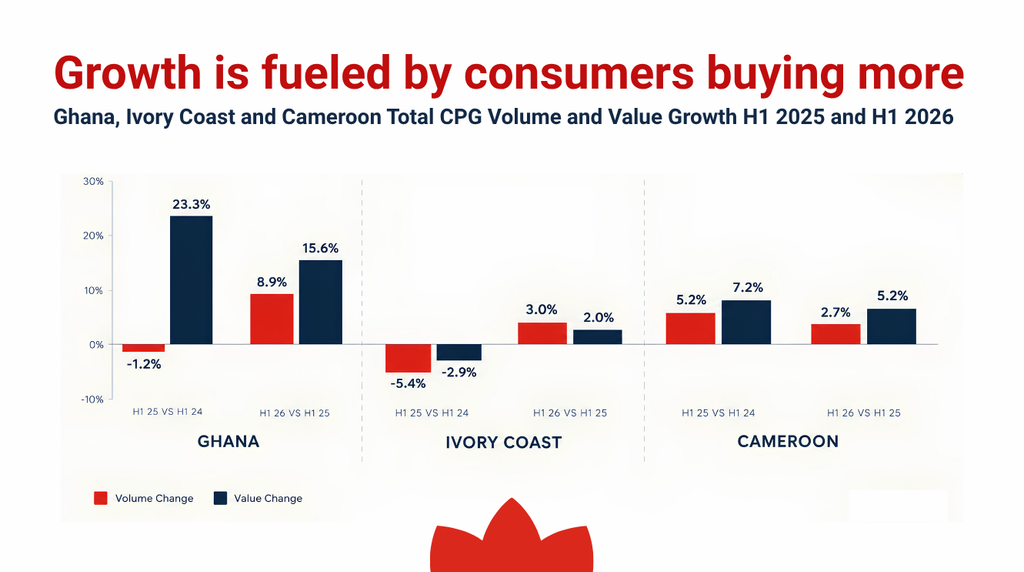
Its syndicated retail audit shows Ghanaian CPG volumes increasing 8.9% in the first half of 2026, alongside value growth of 15.6%.
That distinction matters. For several years, impressive-looking value growth across many emerging markets has often been heavily influenced by inflation. In Ghana, consumers are now not simply paying more. They are buying more.
The composition of that growth is equally revealing. Food increased its share of CPG volume from 32.2% to 34.2%, with edible oil, tomato paste, milk, noodles and food seasonings among the categories driving the recovery.
Improving purchasing power, easing inflation and a stronger cedi have helped consumers rebuild their baskets.
Yet the recovery is not simply a Ghana story. Maverick’s data show Côte d’Ivoire recording approximately 3% volume growth in the first half of 2026 and Cameroon 2.7%.
And therein lies an important lesson for any company considering investment in the region:
West Africa is not one consumer market.
Different countries — and increasingly different regions and cities within those countries — are moving at different speeds and responding to different economic forces.
The opportunity is significant. But winning requires a different playbook.
Perhaps the most interesting evidence comes from companies already succeeding in the region.
Nestlé, as already mentioned, is a particularly good example.
Rather than treating West Africa simply as an export market, the company has built substantial local capabilities and adapted global brands to local consumers.
MAGGI has become deeply embedded in West African cooking, while MILO illustrates how a global brand can be adapted to local tastes and supply chains. Nestlé has used locally sourced ingredients in market-specific formulations and built manufacturing capabilities across the region.
The lesson is deceptively simple:
A global brand does not require a globally identical proposition.
Indeed, Nestlé’s 2025 results reported double-digit MAGGI growth in key markets including Central & West Africa, while MILO was also among the company’s strong growth brands.
This is localisation not as a marketing initiative, but as a business model.
The results are striking. Maverick data shows Maggi in 91% of stores in Cameroon where it holds an 80% share, while Milo is in 85% of stores in Ghana and holds a 60% share.
Sometimes however the route to the consumer matters more than the product
Fan Milk provides another instructive example. Founded in Ghana and now majority-owned by Danone, Fan Milk built its West African business around a simple insight: conventional retail infrastructure should not determine where consumers can access your product.
Its distinctive network of vendors, bicycles and carts took chilled products directly to consumers rather than waiting for consumers to visit conventional stores.
Today the model is evolving, but the underlying principle remains highly relevant.
Don’t wait for West African retail to look like European retail. Build a route to market around how consumers actually shop.
That approach continues to produce impressive results. Fan Milk Ghana’s revenue increased strongly in 2025, passing GH¢1 billion, with further strong growth reported during the first half of 2026.
For a CPG company evaluating West Africa, route-to-market capability may therefore deserve as much attention as category attractiveness.
Traditional trade remains enormously important. Outlet universes can be fragmented. Availability varies dramatically. Secondary cities can behave differently from capitals.
Fan Milk’s experience points to something broader — and Maverick’s data suggest it remains just as important today. Across 95 leading CPG brands in Ghana, Maverick finds a 0.71 correlation between weighted distribution and market share, rising to 0.85 when brands are compared within their categories. Brands expanding distribution also tend to gain share.
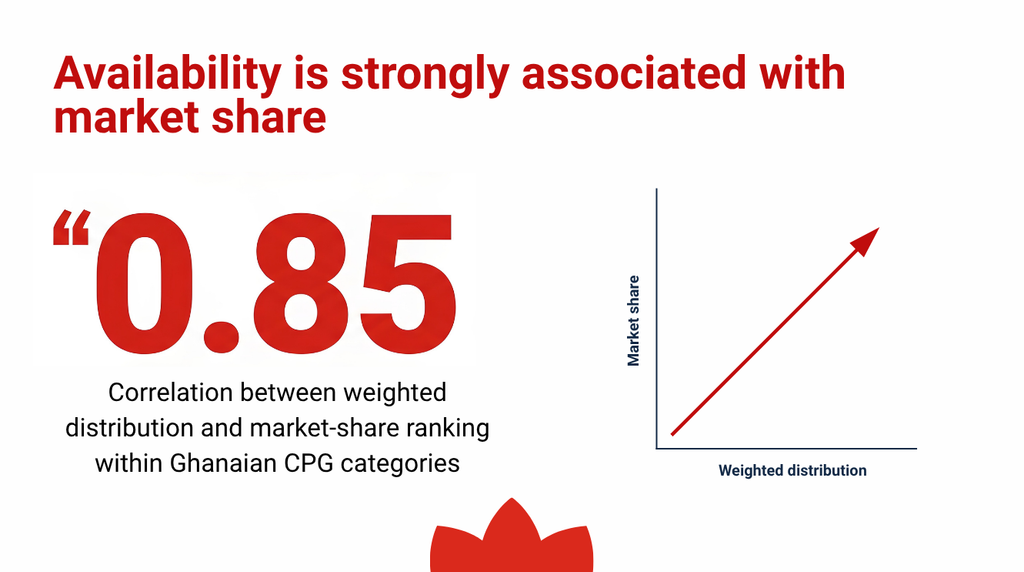
In other words, in Ghana, being available isn’t simply an execution metric. It is strongly associated with winning.
The experience of individual brands reinforces the point. 80% of Ghana’s five biggest share gainers over the past two years — Viju, Verna, Malta Guinness, Geisha and Bigoo — expanded their distribution. While pricing also mattered for some brands, wider availability was the most consistent factor separating the winners.
Maverick also identifies brands such as Milo, Cerelac and Lipton whose rate of sale significantly exceeds what their distribution alone might predict — suggesting that availability and genuine consumer pull need to work together.
Affordability is not the enemy of growth. It is often the unlock.
A second lesson emerges from the data: winning in West Africa requires a sophisticated understanding of affordability.
In Ghana, Maverick recorded average prices per kilogram falling by 8% for edible oil and 6% for pasta as consumption recovered.
Côte d’Ivoire provides an even clearer example. CPG volume grew faster than value during the first half of 2026. Prices declined across staples including edible oil, tomato paste, pasta and tea — and volumes responded.
This challenges one of the more simplistic emerging-market growth narratives.
The opportunity is not merely to wait for an emerging middle class to become wealthy enough to purchase increasingly premium products.
It is to design profitable growth around the consumer’s affordability threshold.
Pack architecture, accessible price points, local sourcing, promotion and cost-efficient distribution therefore become fundamental strategic capabilities.
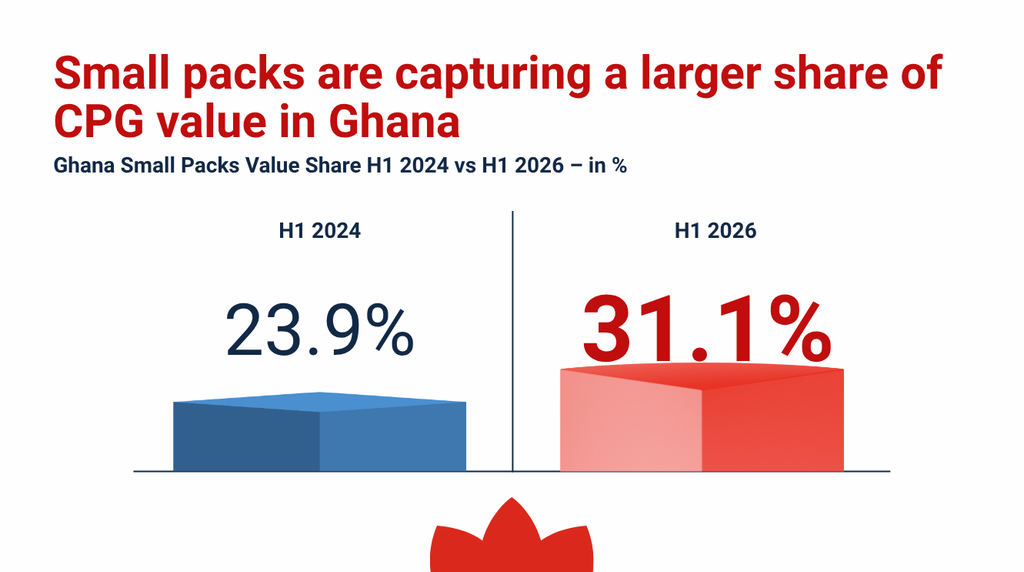
Affordability, however, does not simply mean being cheap. Maverick’s Ghana data reveals a more nuanced picture. Small packs have increased their share of CPG value from 23.9% in H1 2024 to 31.1% in H1 2026, growing 32% in value and 25% in volume in the latest year. Meanwhile, mid-priced products — rather than the lowest-priced tier — have been the strongest value performers.
The implication is important. Consumers may still aspire to established brands, but increasingly want to access them at manageable cash outlays. Brands including Nescafé, Geisha and Nido are responding through smaller formats, sachets and price-pack architecture. In West Africa, affordability may therefore be less about being the cheapest brand and more about engineering the right entry point into the brand.
Local relevance doesn’t require being local
It is tempting to assume that local brands should be the natural winners in markets such as Ghana. They are closer to consumers, understand local tastes and can often operate at lower price points.
The data tells a different story. Maverick estimates that multinational and other foreign brands account for 83% of measured CPG value in Ghana — and they are gaining, not losing, ground. Their value sales grew 15% in the latest year compared with 10% for local brands, whose share has fallen from 17.0% in H1 2024 to 15.4% in H1 2026.
The lesson may therefore be more encouraging for global CPG companies than conventional wisdom suggests. Local relevance does not require being a local company.
What matters is whether global businesses can combine their advantages in brand equity, innovation and commercial capability with the affordability, distribution and consumer understanding required locally.
This is an area where better market measurement reveals opportunities — and threats — that global dashboards historically struggled to see.
Perhaps the problem has not just been opportunity. It has been visibility.
This brings us to an underappreciated barrier to investment in West Africa which is information.
Global CPG management teams have become accustomed to extraordinary visibility.
In established markets, executives can analyse categories, channels, competitors, pricing, promotions and distribution in remarkable detail. Increasingly, they expect near-real-time information on consumer and retail behaviour.
Historically, parts of Africa have been considerably harder to measure, particularly given the importance and fragmentation of traditional trade.
This can create a dangerous circularity. Companies invest less because they understand the market less. And because they invest less, they never develop the data and capabilities required to understand it properly.
That information gap is beginning to close. Maverick Research’s data, for example, allow companies to move beyond national growth rates to understand which price tiers are growing, how pack sizes are changing, where distribution is driving share, which brands are winning and how performance differs between regions.
That matters beyond market research as better information reduces investment uncertainty.
And as measurement improves, companies may discover that some markets previously classified as “too difficult” were actually too difficult to see.
Three rules for winning
The evidence points towards three principles for CPG companies considering West Africa.
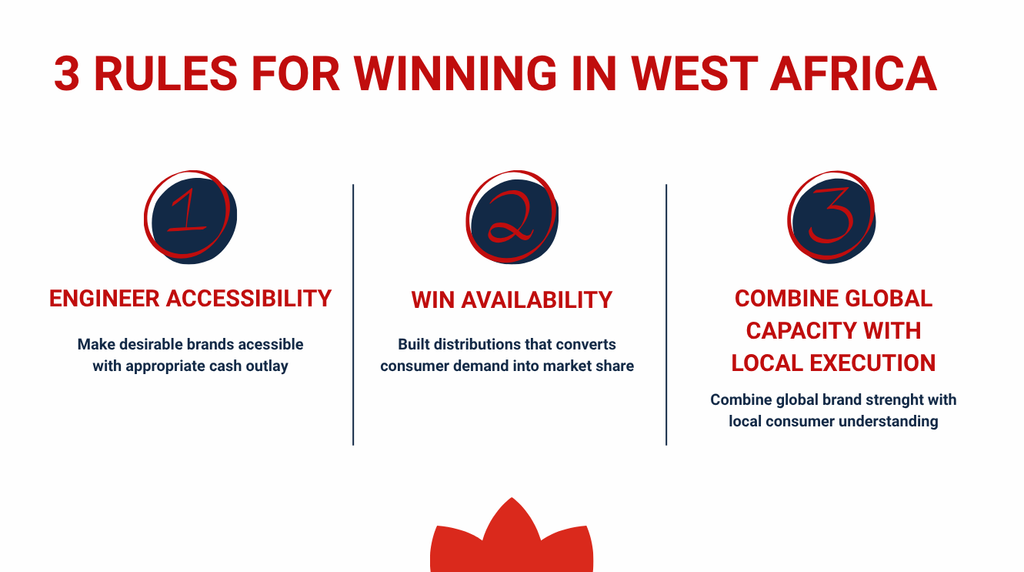
1. Engineer affordability — don’t simply chase the lowest price.
Ghana’s fastest growth is coming from small packs, while mid-priced products are gaining value share. The opportunity is to make desirable brands accessible at a cash outlay consumers can afford, rather than simply competing at the bottom of the market.
2. Win the battle for availability.
Across 95 leading Ghanaian brands, Maverick finds a strong relationship between weighted distribution and market share. Four of the five biggest share gainers over the past two years also expanded distribution. In fragmented retail environments, availability isn’t just execution — it can be competitive advantage.
3. Combine global capability with local execution.
Multinational and other foreign brands already account for 83% of measured CPG value in Ghana and are growing faster than local brands. The evidence suggests global companies don’t need to become local companies to win — but they do need to compete with local understanding of consumers, affordability, distribution and market differences.
But knowing how to win is only part of the equation. Global CPG companies must also decide how they want to participate.
Investing doesn’t always mean owning everything
Recent moves by some of the world’s largest consumer businesses also reveal another important development.
Global CPG companies are reconsidering not simply where they participate, but how.
Diageo, for example, has sold its controlling shareholdings in Guinness Nigeria and Guinness Ghana as it moves towards a more asset-light model across parts of Africa.
But that should not automatically be interpreted as retreat. In Ghana, Diageo retained ownership of Guinness and its other brands, with the brands licensed under a long-term agreement. It continues to control brand and marketing strategy while leveraging the local operating capabilities of its partner.
Coca-Cola has similarly refranchised bottling operations in Ghana and sold finished-product operations in Nigeria as part of its wider approach to bottling ownership.
The distinction is important.
Reducing ownership of physical assets is not the same as reducing exposure to African consumers.
For global CPG companies, West African participation can take many forms: wholly owned operations, joint ventures, local manufacturing partnerships, acquisitions, licensing, franchising and distributor models.
The strategic question should therefore not simply be:
“Should we invest in West Africa?”
It should be:
“What is the most effective operating model through which we can capture the opportunity?”
Nor should anyone underestimate the risks
None of this makes West Africa easy.
Currency volatility, inflation, infrastructure, energy costs, political and regulatory uncertainty and fragmented distribution can dramatically change the economics of a business.
This is precisely why granular local understanding matters. Maverick’s current data illustrate the point. Ghana, Côte d’Ivoire and Cameroon are all recovering, but in different ways. Ghana is experiencing broad consumer recovery. Côte d’Ivoire’s growth is more closely linked to improving affordability. Cameroon’s recovery remains narrower and more food-led.
Even within Ghana, commodity prices can produce very different effects. Gold supports foreign exchange earnings and currency stability, while changes in cocoa prices can materially affect household incomes in cocoa-producing communities.
The differences can exist within countries as well as between them. Maverick’s data show Frytol, for example, losing 13.5 percentage points of share in Greater Accra while gaining 10.8 points in Ashanti over the same period.
A national GDP number can never tell a CPG company enough about where to place its bets.
Put West Africa on the map — then do the homework
For global FMCG leadership teams, the conclusion should not be that West Africa is “the next China.” That would underestimate both the complexity of West Africa and the unique characteristics that drove China’s extraordinary development.
The conclusion is simpler. West Africa deserves to compete for investment capital alongside the markets already sitting on global FMCG growth agendas.
Consider the contrast. While Ghana’s measured FMCG volumes grew 8.9% in H1 2026, Indonesia recorded a 0.4% volume decline in 2025, and according to Worldpanel, Vietnam has experienced declining in-home FMCG volumes. Meanwhile, local and regional manufacturers account for more than half of FMCG value across Southeast Asia’s six major economies, compared with just 17% for local brands in Ghana.
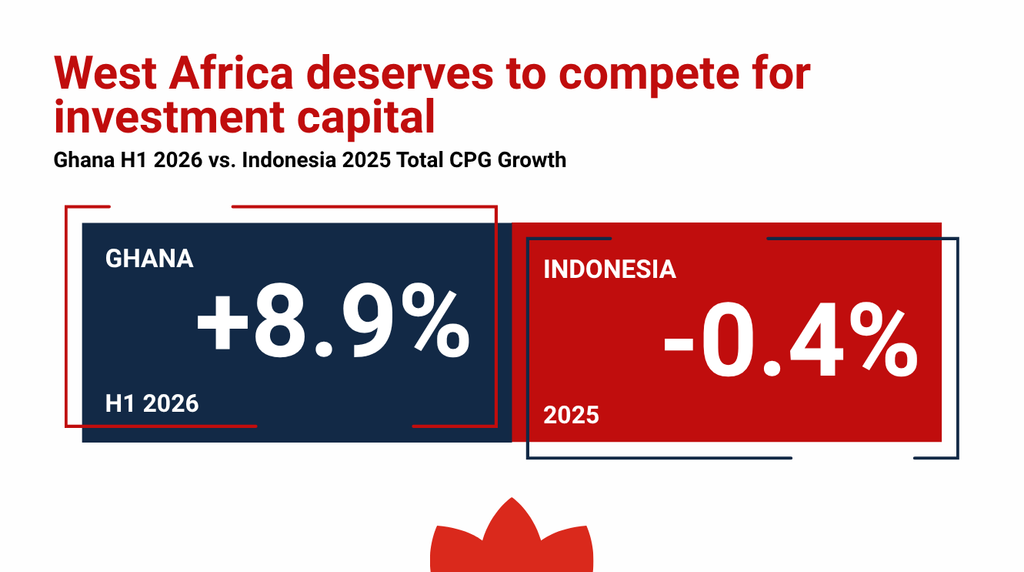
These are different markets and measurement periods, but they raise an important question: Are global FMCG companies allocating investment based on where the next dollar can generate the greatest profitable growth, or simply prioritising the largest and most familiar markets?
The experiences of Nestlé, Danone/Fan Milk and other multinationals demonstrate that attractive growth can be captured in West Africa, provided companies get localisation, affordability and route-to-market execution right. And the strategic shifts of Diageo and Coca-Cola show that participating in the opportunity need not require the capital-heavy operating models of the past.
There is no single West African playbook. But there is a compelling reason to look harder.
For FMCG leaders deciding where the next decade of growth will come from, perhaps the first question isn’t “Should we invest in West Africa?”
It is “Do we understand West Africa well enough to make that decision?”
As better measurement brings these markets into sharper focus, some global FMCG companies may discover that one of their most interesting growth opportunities has been hiding in plain sight.
At Sevendots, we help CPG companies identify and capture new sources of sustainable volume growth, including opportunities for geographical expansion. From prioritizing attractive markets and categories to developing winning consumer propositions, route-to-market strategies and operating models, we combine global CPG expertise with local market understanding. Our team brings extensive senior leadership experience across strategy, marketing, sales and operations, gained within many of the world’s leading consumer goods companies. If you are exploring new growth opportunities in West Africa or beyond, reach out to us to discuss how we can help turn market potential into profitable growth.
