Business Strategy, Innovation 23 September 2026
Don’t Localize the Category. Localize Your Strength.
What Coca-Cola’s resurgence in China can teach global CPG companies about volume growth, localisation and customer activation.
Sevendots, Singapore
7 minute read
Introduction
For the world’s largest CPG companies, two challenges have become increasingly difficult to ignore.
The first is volume growth.
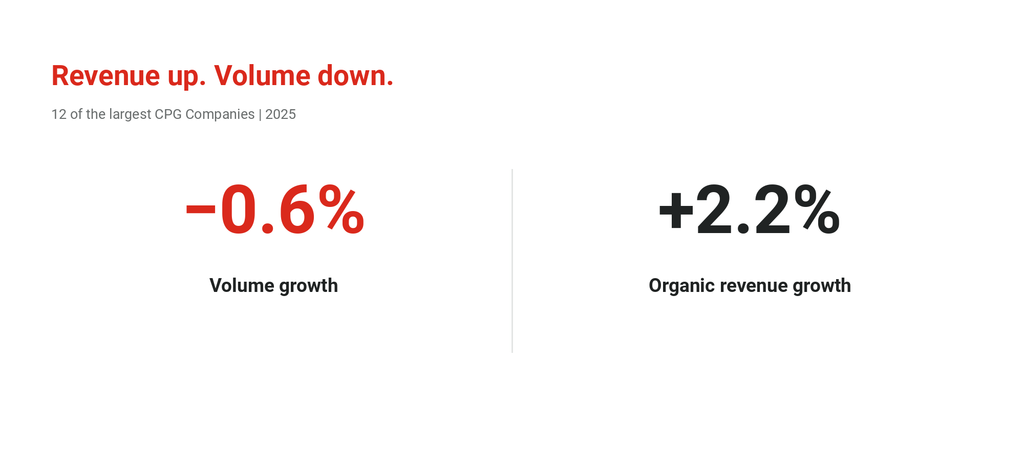
Sevendots analysis shows that in 2025 volume across the twelve largest global CPG companies contracted by 0.6%, despite organic revenue growth of 2.2%. Pricing continued to support revenues, but physical consumption was going backwards. Encouragingly, 2026 has begun to look different, with more of the leading CPG companies returning to volume growth (see our Q2 2026 CPG volume-growth analysis here).
The second challenge is arguably even more difficult: winning in China.
For many multinational CPG companies, China has become one of the toughest markets in the world. Local competitors have become faster, more innovative and increasingly sophisticated. Digital commerce has transformed how products are discovered, tested and scaled. And Chinese consumers are increasingly comfortable choosing local brands.
Against that backdrop, Coca-Cola’s recent performance deserves attention.
From 1% Growth to 8%
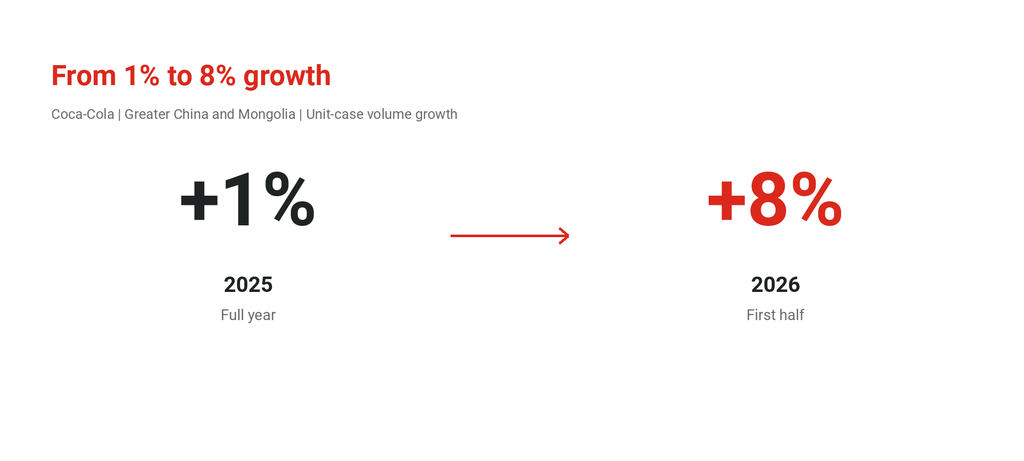
In 2025, Coca-Cola’s unit-case volume in Greater China and Mongolia grew just 1%.
By the first half of 2026, growth had accelerated to 8%.
China was one of the markets leading Coca-Cola’s global volume growth in Q2.
This matters beyond Coca-Cola.
At a time when many global CPG companies are searching for sustainable volume growth and questioning how multinational brands can compete effectively in China, Coca-Cola provides an interesting case study.
And perhaps the most important lesson is not simply that Coca-Cola is innovating.
It is how it is innovating.
Coca-Cola Hasn’t Abandoned Its Core
It would be easy to assume that winning in China requires multinational companies to chase the categories where local competitors are growing fastest.
Coca-Cola’s experience suggests something more nuanced.
Globally, Coca-Cola remains fundamentally a sparkling beverage company. In fact sparkling soft drinks account for around two-thirds of worldwide unit-case volume.
Asia Pacific is somewhat more diversified. Trademark Coca-Cola represents around a third of regional volume, other sparkling flavours just over a quarter, and water, sports, coffee and tea almost another third.
Yet sparkling beverages remain at the heart of the business.
So Coca-Cola’s response in China has not been:
“Our traditional categories don’t work here. What new categories should we enter?”
It has increasingly been:
“How do we make the capabilities and brands in which we already have a strength more relevant to Chinese consumers?”
That distinction is strategically important.
Sprite + Tea: a Small Product With a Big Lesson
Coca-Cola has driven many innovations in China including prebiotic variants, electrolyte/hydration propositions and continued development of tea products.
However Sprite + Tea is one example that illustrates the point particularly well.
The original innovation emerged from a behaviour observed in the United States: consumers posting videos of themselves putting tea bags directly into Sprite.
Coca-Cola picked up on the behaviour, launching a limited edition Sprite + Tea across US and Canada in 2025.
But when Coca-Cola brought the concept to China, it didn’t simply export the American product.
It adapted it.
The Chinese version has a more lemon-forward flavour profile designed around local preferences. And it has an amber/brown visual appearance associated with tea, an important cue for Chinese consumers.
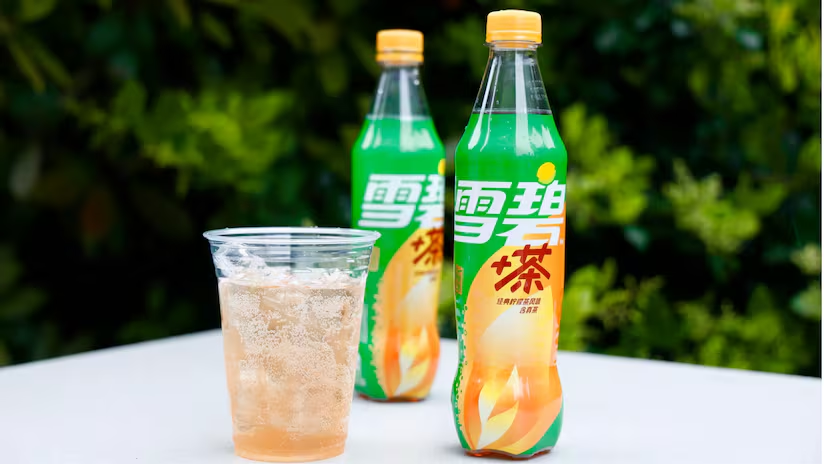
Coca-Cola specifically identified the innovation as contributing to Sprite’s volume growth in China during Q2 2026.
The interesting thing is that Coca-Cola didn’t conclude:
“China loves tea, so let’s become a tea company.”
Instead, it asked:
“How can one of our global strengths – sparkling beverages – intersect with something deeply relevant to Chinese consumers?”
That is a very different philosophy of localisation.
And it leads to what I believe is the broader lesson:
Don’t Localise the Category. Localise Your Strength.

Localisation goes beyond flavour
The principle can be seen elsewhere in Coca-Cola’s China business.
The company has been developing functional sparkling propositions, responding to growing Chinese consumer interest in health and functionality without abandoning its core competence in beverages.
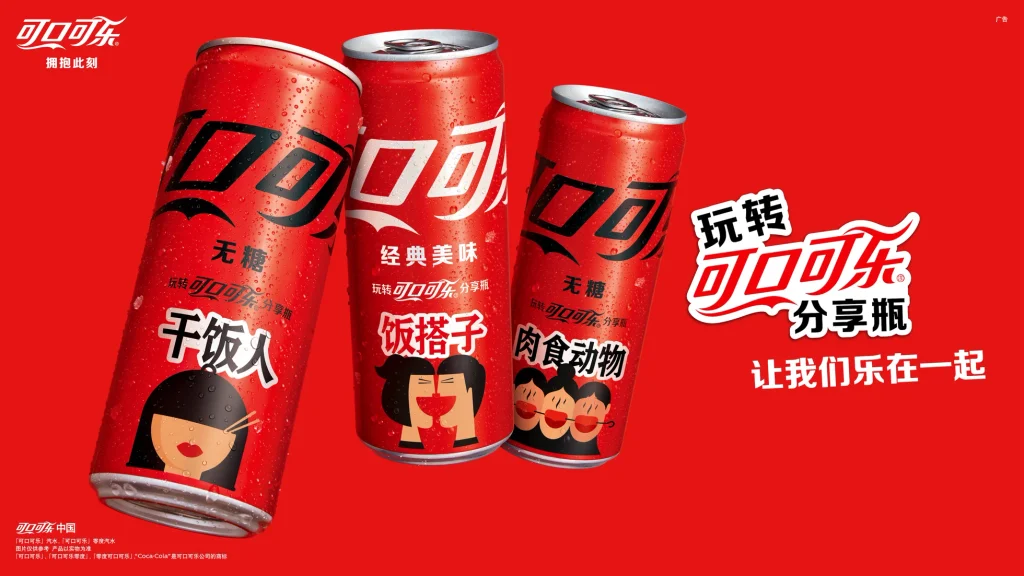
Its Share a Coke activation was also localised around social identities and behaviours relevant to younger Chinese consumers rather than simply reproducing the Western campaign.
And Coca-Cola is increasingly talking about innovation hubs that translate consumer insights into locally relevant products, with successful ideas then capable of being transferred elsewhere.
Global scale remains an advantage. But local markets increasingly determine how that advantage should be expressed.
But consumers are only half the equation
There is another reason why Coca-Cola is successful in China.
A locally relevant product achieves little if consumers cannot find it, retailers don’t support it or execution is poor.
Innovation Needs to Win Twice: With the Consumer and With the Customer.
Recent Advantage Group International research in China highlights just how important this is.
Across the market, retailers identify product innovation as one of the weakest supplier competencies. The research points to a substantial mismatch between the pace of innovation retailers would like to see and what manufacturers are perceived to be delivering.
Against this background, Coca-Cola’s movement is striking.
In the 2026 Advantage Report, Coca-Cola increased its score by 27 points to 60 and jumped eight places in the rankings.
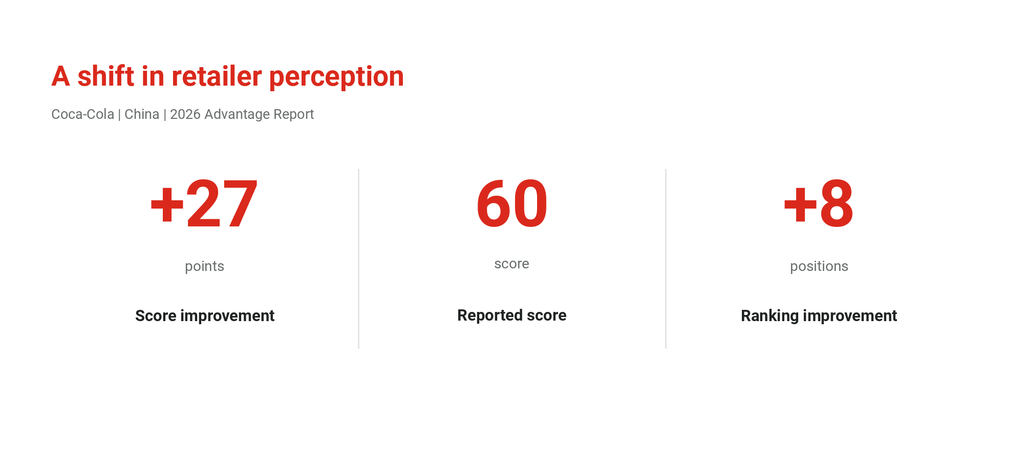
That is a substantial change in retailer perception.
It suggests that what is changing at Coca-Cola extends beyond its consumer innovation pipeline. The company appears to be getting better at translating innovation into customer value and marketplace execution.
This is consistent with Coca-Cola’s broader move towards Collaborative Business Planning – building shared strategic agendas with retailers rather than treating customer planning primarily as a mechanism for selling manufacturer priorities.
And that matters particularly in China.
The Chinese route to market now spans traditional supermarkets and hypermarkets, convenience, emerging discount formats, Away from Home, Alibaba and JD ecosystems, Douyin and other digital platforms.
Innovation therefore isn’t finished when R&D creates the product.
Distributed Innovation Model
This suggests a broader way of thinking about the Coca-Cola case.
The growth equation isn’t simply:
Innovation → Volume
It is closer to:
Global capability × Local consumer insight × Customer collaboration × Execution = Volume growth
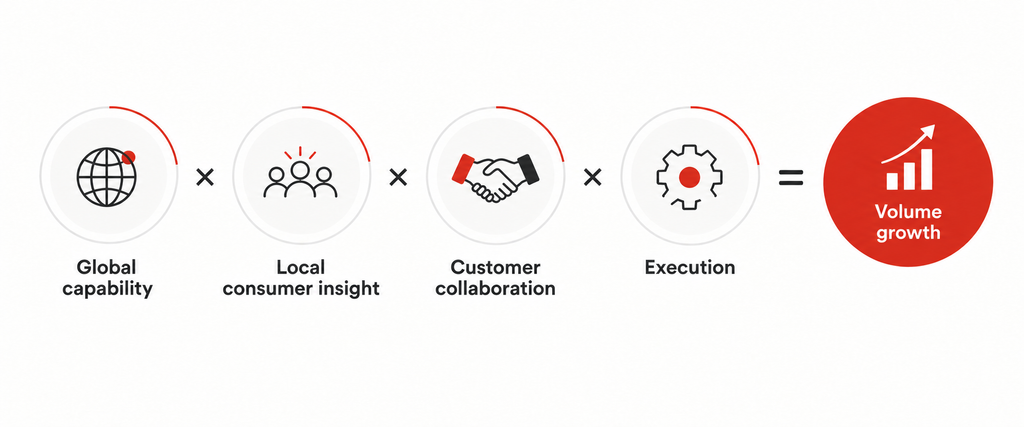
Each component matters.
Global capability provides brands, technology, R&D, manufacturing expertise and scale.
Local consumer insight makes those capabilities culturally and functionally relevant.
Customer collaboration turns the proposition into something retailers and platforms want to support.
Execution ensures consumers can actually find, experience and buy it.
Remove any one of the four and innovation becomes significantly less powerful.
Importantly, Coca-Cola is now embedding this philosophy into the way it organises innovation.
In 2026, the company announced that it is establishing innovation hubs across each of its operating units, with responsibility for translating consumer insights into locally relevant innovation. Rather than relying predominantly on ideas flowing from the global centre into individual countries, the intention is to create innovation closer to consumers – and then identify the strongest ideas and rapidly “lift and shift” them across markets.
This potentially changes one of the traditional advantages of being a multinational. Scale no longer has to mean standardisation. An idea can originate in one market, be adapted in another and, if successful, be scaled through Coca-Cola’s global system. Sprite + Tea is a good example: an idea commercialised first in the US was reformulated around Chinese tastes, while other Coca-Cola innovations are moving in the opposite direction – from one local or regional market into the wider global portfolio.
The emerging model is therefore less “global innovation, local execution” and more “local insight, distributed innovation, global scaling.” The global organisation still provides the brands, capabilities and scale; increasingly, however, the markets closest to consumers help determine where the next growth idea comes from.
The Multinational Paradox
This brings us to one of the central challenges facing multinational CPG companies in China.
Scale has historically been their greatest competitive advantage.
Global brands. Global R&D. Global procurement. Global manufacturing. Global marketing platforms. Global talent.
But scale can create its own weaknesses.
More approval layers. Longer innovation cycles. Global guardrails. Standardised propositions. And an understandable desire to leverage every successful idea across multiple countries.
Local Chinese competitors often operate differently.
They can identify an emerging behaviour, develop a proposition, test it through digital channels, collect consumer feedback and iterate – sometimes while a multinational is still navigating its internal approval process.
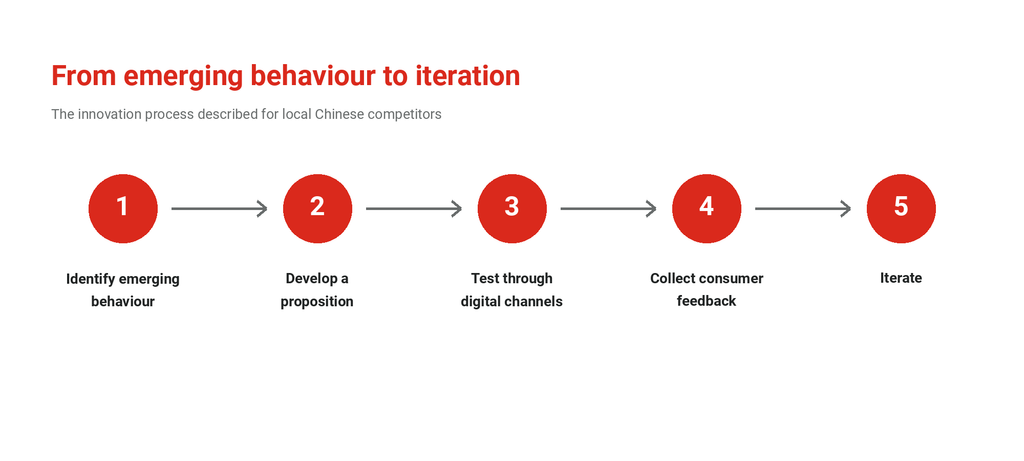
The answer, however, isn’t necessarily for multinational companies to try to become local companies.
They probably can’t.
Nor should they throw away the advantages that made them global businesses in the first place.
Instead, the challenge is to combine multinational scale with local obsession.
This is an important lesson from Coca-Cola China.
Coca-Cola appears to be demonstrating that global scale and local agility don’t have to be opposing forces.
The objective isn’t to participate in every locally fashionable category.
Nor is it to take a global portfolio and simply translate it for China.
It is to identify the capabilities where the company genuinely has a right to win, and then relentlessly adapt those advantages around local consumers, local customers and local channels.
That distinction matters far beyond beverages.
For global CPG companies searching simultaneously for volume growth and a formula for winning again in China, perhaps the lesson isn’t to become less global.
It is to become much better at making global advantage matter locally.
Don’t localise the category. Localise your strength.
How Sevendots Can Support
At Sevendots, we help brands unlock pathways to volume growth, which includes building the right brand and category plans in close collaboration with your retailer partners. Our team has extensive senior sales, strategy and marketing expertise, gained through experience working within many of the largest FMCG companies around the world. Reach out to us if you are looking for support to drive out-sized growth in 2026 and beyond.