Business Strategy, Value Chain 27 April 2026
Value Chain resilience in CPG: From Supply Chains to data-driven value networks
Resilience is no longer a safeguard; it is a primary driver of growth and competitive advantage.
Value chains are shifting from linear, siloed models to real-time, data-driven networks.
The next frontier is clear: autonomous, intelligent, and customer-centric ecosystems.
Sevendots, Milan
8 minute read
Efficiency is no longer enough: resilience becomes the new performance driver
The Consumer-Packaged Goods (CPG) and grocery retail sectors have faced unprecedented challenges over the past few years, including supply chain disruptions, changing consumer behaviors, and the impacts of global events such as the COVID-19 pandemic and the geopolitical crisis.
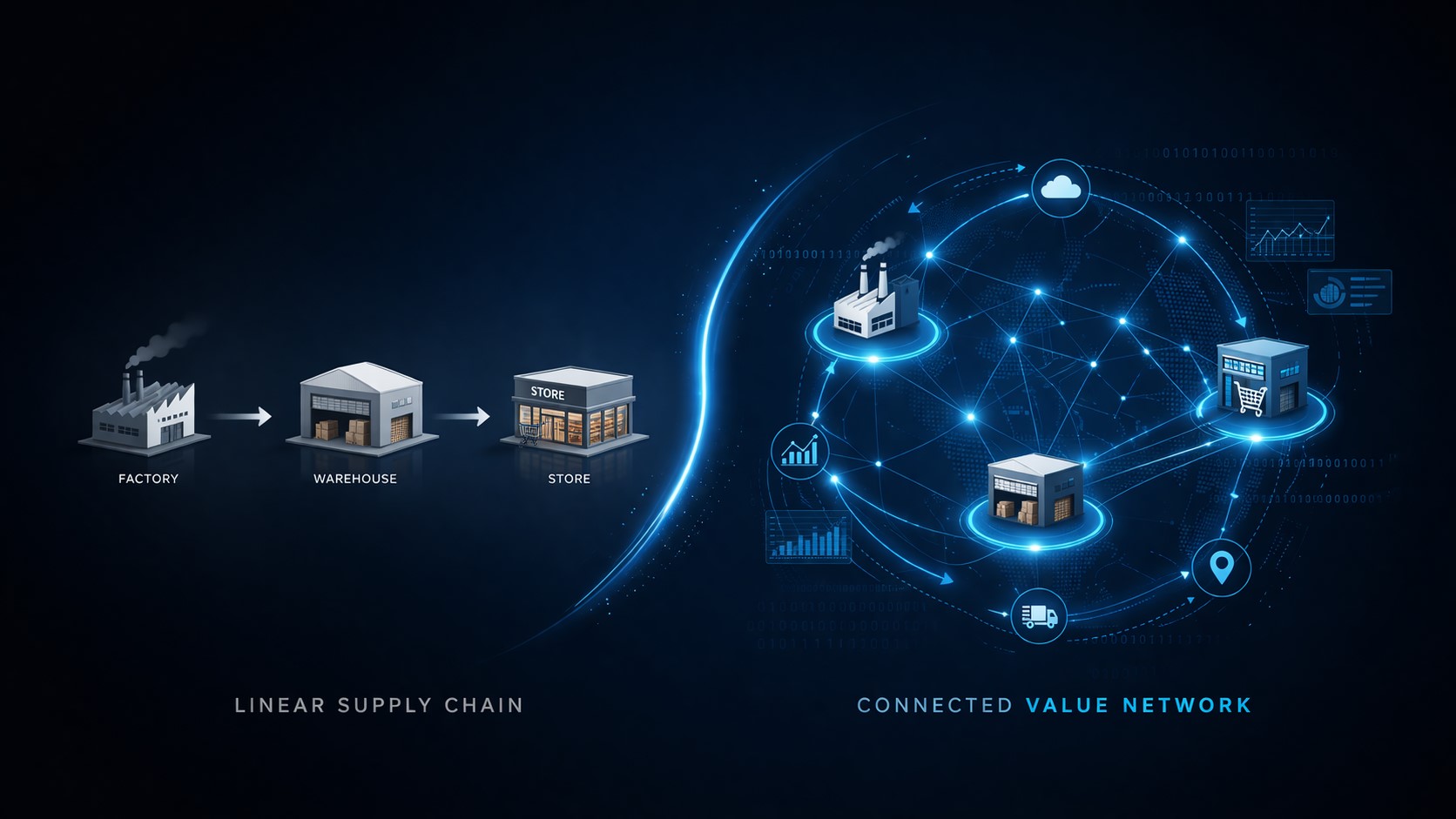
In today’s competitive and demand-driven markets, the interconnection between producers and distributors is no longer optional; it is a strategic necessity. The traditional linear supply chain model has evolved into a dynamic, data-driven value network where information flows in real time across stakeholders. This transformation is enabled by digital technologies such as cloud platforms, IoT, advanced analytics, and integrated ERP systems.
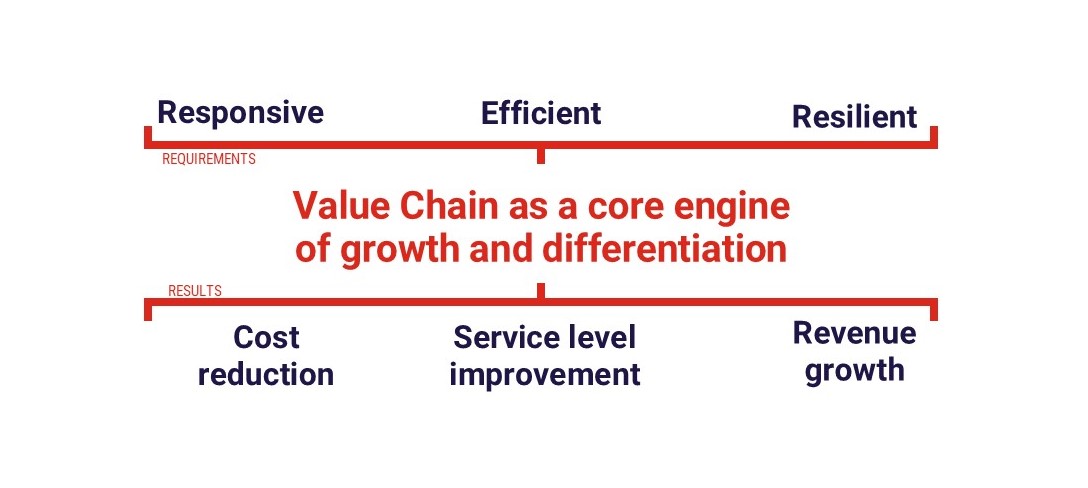
The result is a more responsive, efficient, and resilient value chain capable of reducing costs, improving service levels, and driving revenue growth.
The need for resilient interconnected value chains has never been more critical. This article explores the importance of resilience in CPG and grocery retail value chains, the factors influencing that resilience, and strategies companies can adopt to enhance it.
From linear chains to real-time value networks
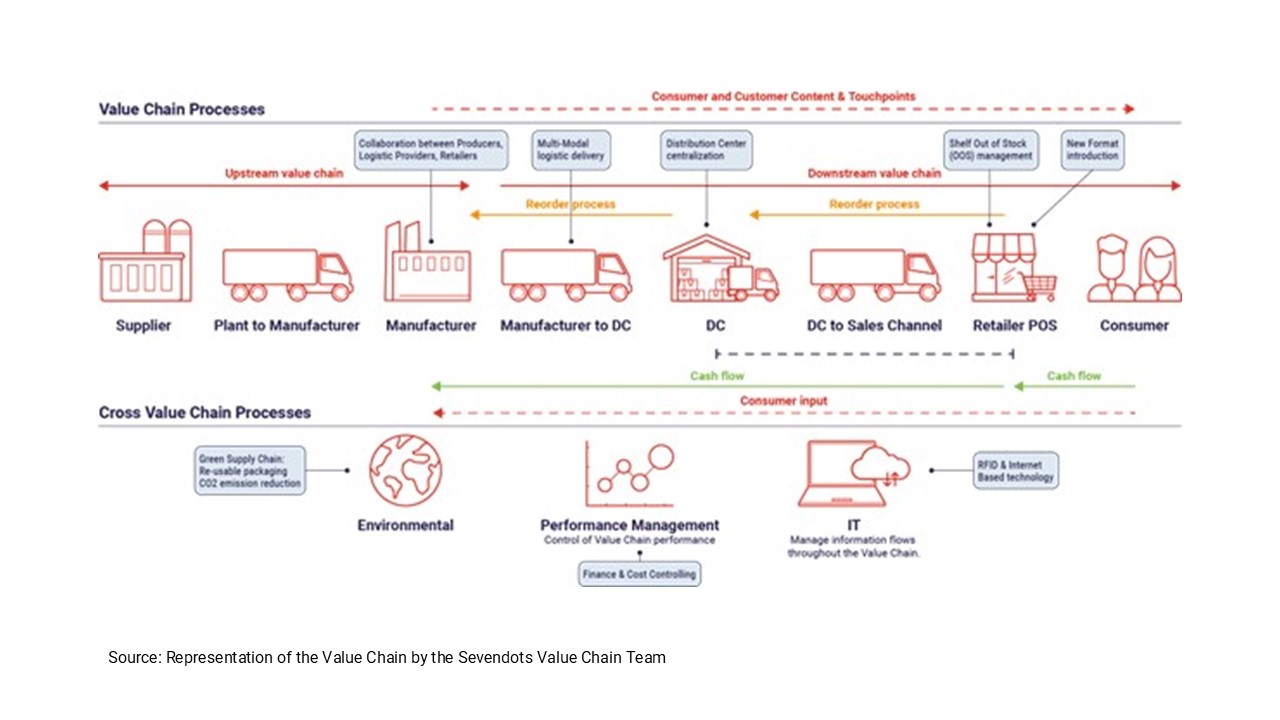
Interconnected value chains represent a fundamental departure from traditional models. Instead of sequential, siloed processes, they operate as coordinated ecosystems where multiple actors collaborate to deliver value to the end consumer. In the CPG sector, these actors often include manufacturers, suppliers, distributors, and retailers.
The complexity of this new coordinated ecosystem is amplified by demand volatility and fast-changing consumer preferences but also by high SKU proliferation, omnichannel distribution and increasing pressure on service levels.
Digital technologies, including cloud platforms, IoT, advanced analytics, AI, and integrated ERP systems, enable this transformation by creating real-time visibility and coordination across the entire value chain.
The result is not simply a more efficient system, but a fundamentally different one: a network that can sense, decide, and respond dynamically.
Volatility, fragmentation, and the end of predictability
Three structural forces are reshaping value chains:
1. Systemic Supply Chain Disruptions: Global events, natural disasters, and geopolitical tensions can disrupt supply chains, affecting the availability of goods. For instance, the current geopolitical tension highlighted vulnerabilities in sourcing and logistics, leading to stock shortages and increased prices.
2. Evolving Consumer Preferences and Fragmentation: The rise of e-commerce, demand for immediacy, and increasing expectations around sustainability have made demand patterns less predictable and more complex to serve. Grocery retailers must adapt by improving their online offerings and sourcing from sustainable suppliers.
3. Market Volatility Intensification: Fluctuations in raw material prices, changing regulatory environments, and shifting economic conditions can create instability within value chains.
Together, these forces are redefining the operating environment: stability is no longer the baseline assumption.
Resilience is not protection; it is competitive advantage
In this context, resilience must be redefined.
It is not simply the ability to withstand shocks, but the capability to adapt quickly while maintaining performance.
In the CPG and grocery retail sectors, resilience can lead to several advantages:
– Sustained Operations: Companies with resilient value chains can continue to meet customer demands despite disruptions.
– Competitive Advantage: Businesses that adapt quickly to changes in consumer behavior and market conditions can outperform competitors.
– Customer Loyalty: Brands that consistently deliver quality products and reliable service foster trust and loyalty among consumers, which is especially important during challenging times.
Ultimately, resilience translates into tangible business outcomes: higher service levels, improved margins, and stronger customer loyalty.
Resilience is engineered: the capabilities that matter
Resilience does not emerge organically; it is built through a set of deliberate capabilities.
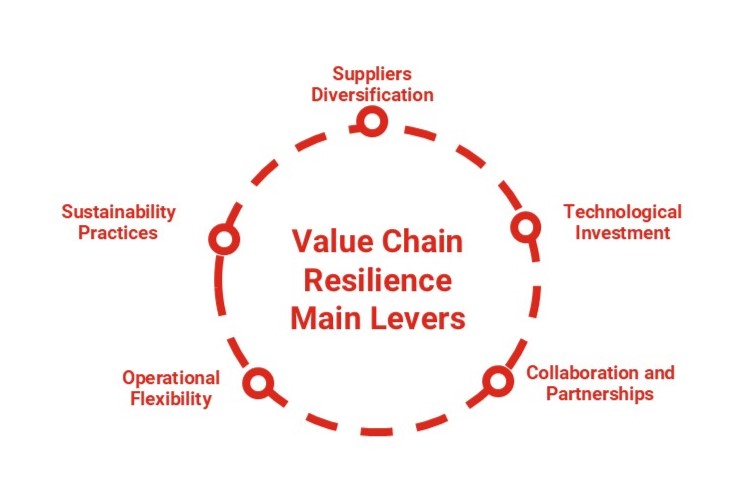
At its core, four levers define a resilient value chain:
1. Diversification of Suppliers: Relying on a single supplier can create vulnerabilities. By diversifying suppliers and sourcing from different regions, companies can mitigate risks associated with supply chain disruptions.
2. Investing in Technology: Embracing technologies such as artificial intelligence (AI), data analytics, and the Internet of Things (IoT) can provide better visibility into the supply chain. These tools help companies anticipate disruptions and make data-driven decisions.
3. Collaboration and Partnerships: Forming strategic partnerships with suppliers, distributors, and retailers can enhance collaboration and communication. Joint initiatives can lead to shared insights, better forecasting, and more efficient operations.
4. Operational flexibility and agility: Developing flexible operations allows companies to respond swiftly to market changes. This may include adjusting product offerings, altering distribution strategies, or implementing dynamic pricing models.
5. Sustainability and Climate Change Management Practices: Incorporating sustainability into the value chain not only meets consumer demands but also enhances resilience by reducing dependency on finite resources. Sustainable practices can lead to improved efficiency and reduction in waste, contributing to overall resilience. Climate change management practices help companies in the sector address raw material challenges in categories such as chocolate (e.g., hazelnuts) and coffee (cultivation).
These capabilities are not independent; they reinforce each other, creating a self-improving system.
Integration is no longer optional; it is the operating model
In today’s competitive and demand-driven markets, the interconnection between producers and distributors is no longer optional, it has become a core requirement for competitiveness.
Modern value chains operate as integrated systems, where planning, production, and distribution are continuously aligned through shared data and collaborative processes.
This transformation is enabled by:
1. Data Integration Platforms: Cloud-based integration platforms allow seamless data exchange between producers and distributors, eliminating silos.
2. Demand Forecasting and AI: Advanced analytics and AI improve forecast accuracy by incorporating real-time sales and external data.
3. Collaborative Planning Systems: Joint planning tools enable producers and distributors to align on forecasts, promotions, and replenishment strategies.
4. IoT and Real-Time Tracking: Sensors and tracking technologies provide visibility into inventory movement and condition across the supply chain.
The value chain is no longer a cost center; it becomes a core engine of growth and differentiation. The result is a more responsive, efficient, and resilient value chain capable of reducing costs, improving service levels, and driving revenue growth.
Business Case 1: Amazon, turning the value chain into a scalable platform
(a closed-loop, self-optimizing, revenue-generating system)(a closed-loop, self-optimizing, revenue-generating system)
Context
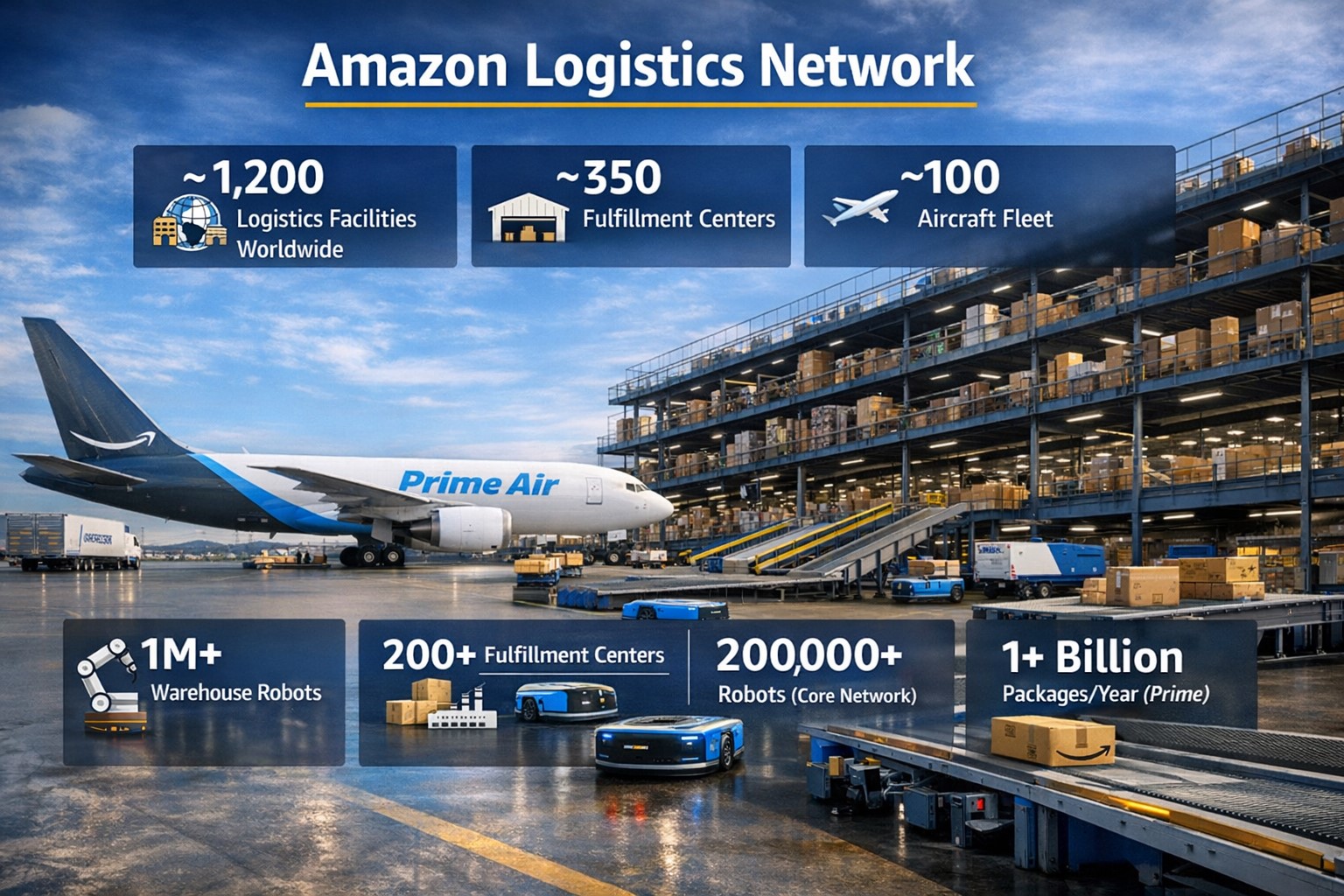
Amazon has redefined the role of the value chain by transforming it from an operational backbone into a monetizable platform.
Strategic shift
The company has moved from being a retailer to becoming an infrastructure provider, where logistics, fulfillment, and data capabilities are offered as services.

What Amazon built
Amazon operates one of the most advanced logistics ecosystems globally, combining:
- large-scale automation and robotics
- AI-driven demand forecasting
- end-to-end control of logistics (including last-mile delivery)
This system processes massive volumes of data daily, enabling continuous optimization.
Key Insights
Amazon’s value chain is not linear; it functions as a self-reinforcing data flywheel, where operations generate data, data improves algorithms, and algorithms optimize operations.
1. AI integration: Advanced ML forecasting reduces: Sales forecast error (–12.7%), Inventory error (–12.4%)
2. robotics systems: robotic picking is trained on 394K+ operations, scaled to 200M+ packages handled
Business impact
This model delivers
- lower fulfillment cost per unit
- faster delivery (same-day / next-day)
- higher inventory turns
- last-Mile and Vertical Integration
At the same time, by opening its infrastructure to third parties, Amazon turns its value chain into a revenue-generating ecosystem, locking in partners and creating new growth streams.
Business case 2: Nestlé, orchestrating complexity at global scale
(a real-time, connected, and sustainable global network)
Context
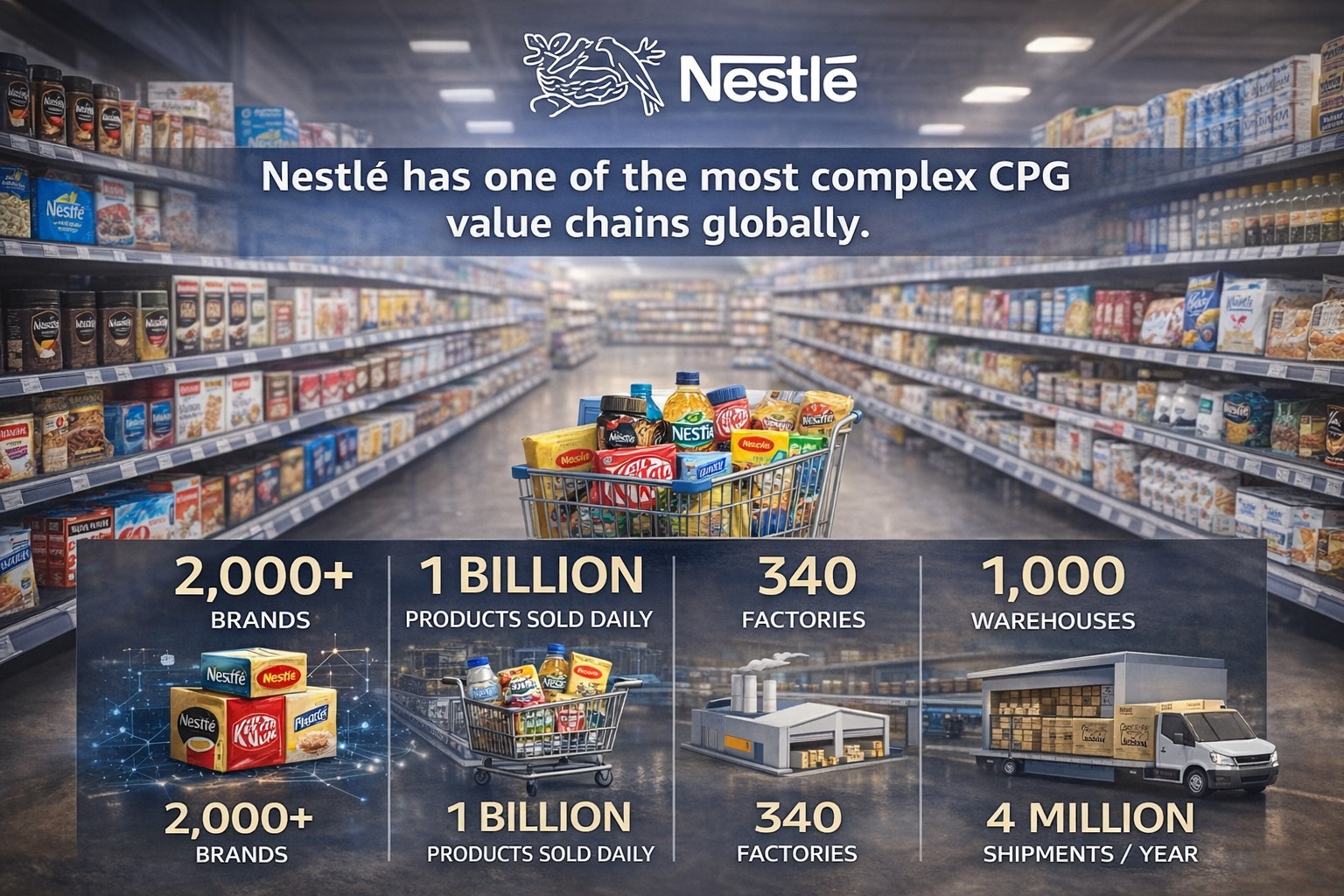
Nestlé operates one of the most complex value chains in the CPG industry, with thousands of brands, factories, and distribution nodes globally.
Strategic shift
The company is transitioning from decentralized, multi-local supply chains to a globally orchestrated and digitally integrated network.

What Nestlé is building
This transformation focuses on:
- integrated planning (finance+supply chain+sales)
- real-time demand visibility
- AI-enabled planning and decision-making
At the same time, Nestlé maintains local execution capabilities to preserve market responsiveness.
Key Insights
Unlike Amazon, Nestlé does not monetize its value chain directly. Instead, it leverages integration to manage complexity and improve efficiency at scale.
1. robotic picking: 900 cases/hour vs 200 manual, +77% productivity,
2. global network: 2M customers, 188 countries served,
3. digital logistics platforms for: visibility, cost reduction, CO₂ optimization, 100,000+ farmers integrated daily (India case), real-time quality + pricing transparency, digital payments and tracking.
Business impact
This transformation enables
- faster product launches
- improved demand-supply synchronization
- higher productivity and reduced waste
The result is a value chain that is not only efficient, but increasingly adaptive and sustainable.
Platform vs orchestration: two paths to value chain leadership
Amazon and Nestlé represent two distinct, but converging, approaches:
- Amazon turns the value chain into a platform and revenue engine
- Nestlé turns the value chain into a capability that manages complexity, drives efficiency and provides competitive advantage.
Amazon vs Nestlé: Comparative Insights
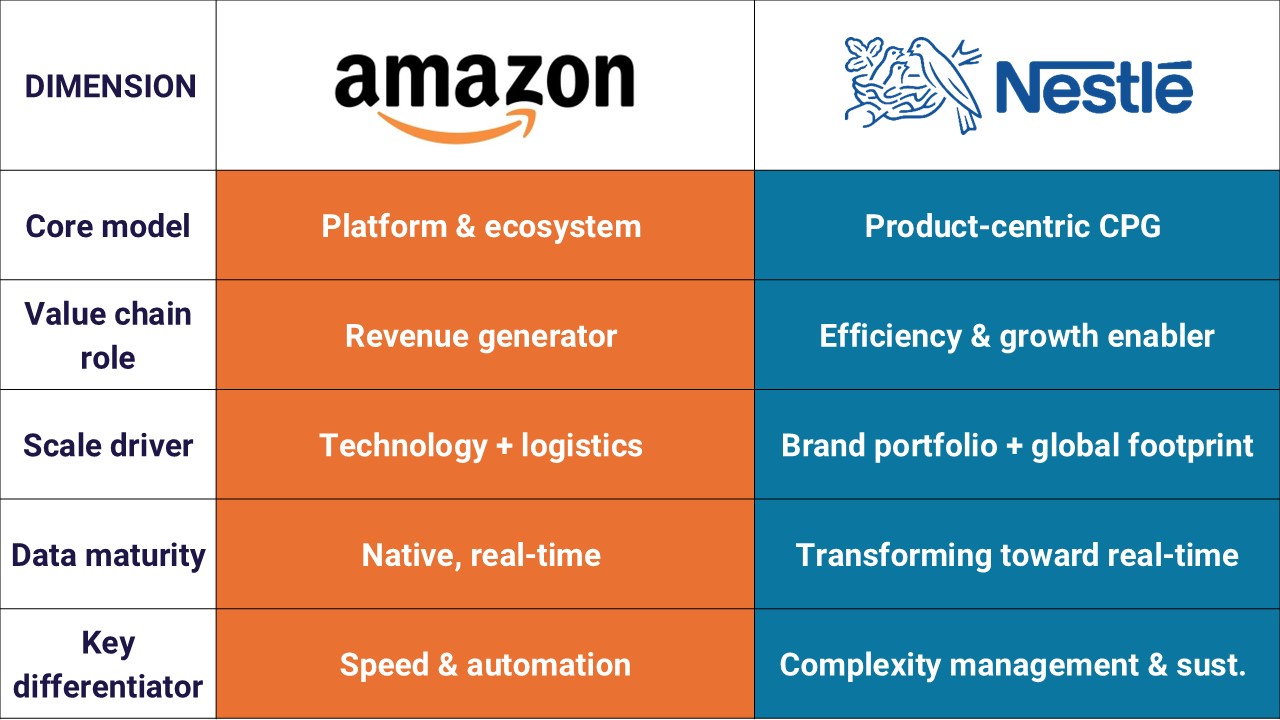
Despite these differences, both models share common principles:
- data-centric decision-making
- end-to-end integration
- value creation (through monetization or optimization)
- growing importance of sustainability
The direction is clear: value chains are evolving into intelligent, interconnected systems.
The rise of intelligent networks
Across industries, a new paradigm is emerging. Value chains are no longer defined by physical flows alone, but by their ability to capture, process, and act on data in real time.
This transformation is driven by:
- digitalization of consumption
- increasing demand volatility
- sustained pressure on margins
As a result, companies are shifting toward:
- omnichannel integration
- AI-driven decision-making
- platform-based ecosystems
- regionalized and resilient supply networks
The value chain is becoming a value network—dynamic, intelligent, and continuously evolving.
Looking ahead, value chains will increasingly move toward autonomy.
Artificial intelligence will not only support decisions but actively manage end-to-end processes. Digital twins will enable real-time simulation and scenario planning. Logistics will become progressively automated, reducing manual intervention.
At the same time, the human role will evolve. Organizations will redesign workflows to enable effective human–machine collaboration, focusing human effort on strategic and creative activities.
Finally, relationships across the value chain will become more digitally integrated. Routine interactions will be automated, while human engagement will concentrate on innovation, trust, and long-term partnerships.
From managing flows to orchestrating customer-centric ecosystems
The transformation of the CPG and grocery retail value chain is no longer optional, it is strategic.
Industry analyses show that only 23% of CPG companies and 28% of Retailers consider their supply chains truly agile, highlighting a structural gap that is accelerating the need to redesign the Value Chain.
The evidence is clear:
- inefficiencies destroy value at scale
- data-driven companies outperform peers
- collaboration across the value chain is the primary value multiplier
The fundamental shift is:
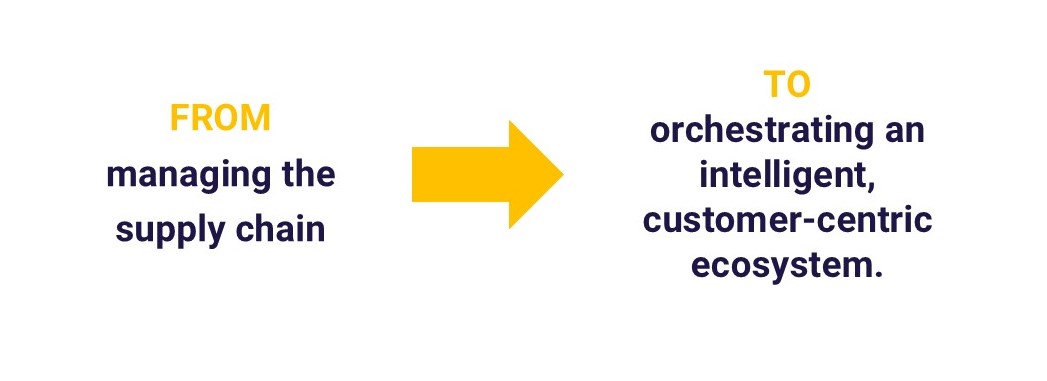
A value chain designed around the concept of customer centricity places the customer at the core of every activity, decision, and process within the organization. Instead of focusing primarily on internal efficiency or product-driven logic, each stage of the value chain, from sourcing and production to marketing, sales, and after-sales service, is aligned to create and deliver maximum value for the customer. This approach requires a deep understanding of customer needs, preferences, and behaviors, supported by continuous feedback and data analysis.
As a result, the company can enhance customer satisfaction, build stronger relationships, and generate sustainable competitive advantage by consistently delivering experiences that meet or exceed expectations.
In an increasingly volatile environment, resilience is not just about surviving disruption, it is about building the capabilities to continuously adapt and win.
How can Sevendots help?
From strategy to execution, resilience must be engineered. At Sevendots, we help CPG companies strengthen their value chains through a combination of strategic design and targeted operational interventions, leveraging senior expertise and a fully integrated perspective across operations, commercial, and financial dimensions.